

Skip to content

Medically reviewed by Dr. Meeta Mungale, MS (Ophthalmology), DNB · Cornea Fellowship, LVPEI · Gujarat Medical Council Reg. No. G-39262 · Reviewed on 3 October 2026

Dr. Meeta Mungale writing at her desk

Dr. Meeta Mungale

MS (Ophthalmology), DNB · Cornea Fellowship, LVPEI

Treatment & Surgery · Cornea

Corneal Treatments

Seven areas of cornea care, each approached according to the condition and clinical need.

Corneal careclinical photograph

Corneal care · 7 areas

010203040506Corneal Treatments

Corneal care

Different conditions.
Different approaches.

Seven areas of cornea care, presented with the conditions, approaches and clinical material used at Mungale.


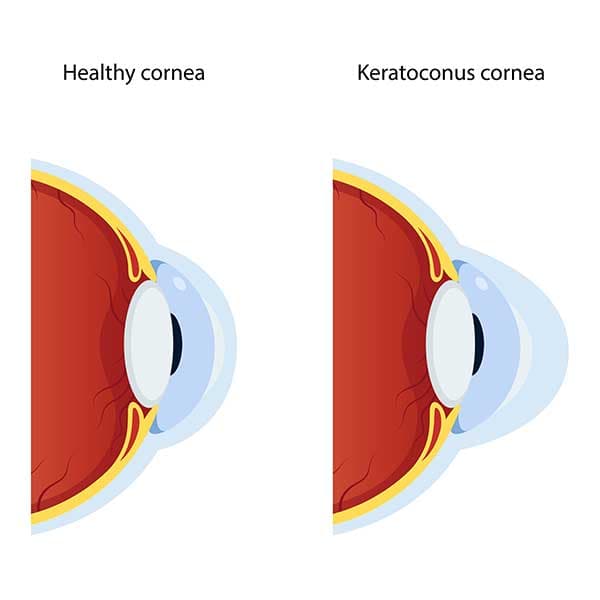
Healthy versus keratoconus cornea illustration

Keratoconusclinical illustration

Keratoconus

A progressive thinning and cone-shaped bulging of the cornea that distorts vision — steadied with cross-linking, specialty lenses, or transplant.

Keratoconus is a progressive eye disease where the cornea thins and bulges into a cone shape, distorting vision. Treatments for progressive keratoconus include: Corneal collagen cross-linking (C3R), Scleral and semi-scleral lenses, Corneal transplant.
Corneal infectionclinical photograph

Corneal Infection

Viral, bacterial or fungal — a microbiology scraping identifies the cause so treatment targets it.

Eye infections can be caused by viruses, bacteria, or fungi. A microbiology test (scraping) helps determine whether it’s bacterial or fungal, guiding treatment.

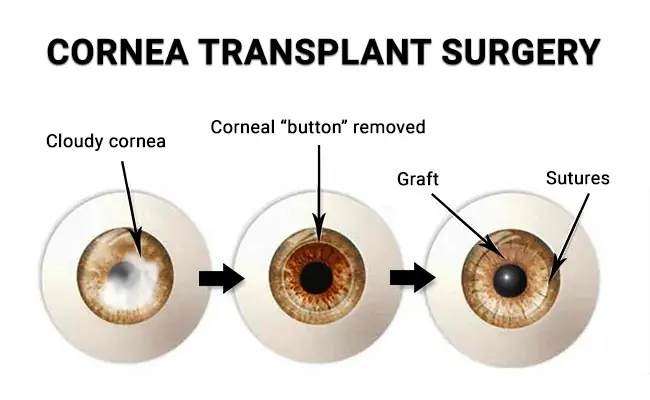
Corneal transplantation surgery diagram used at Mungale Eye Hospital

Transplantationclinical illustration

Transplantation

A diseased cornea replaced with a healthy donor cornea — full thickness, or layer by layer.

Corneal transplantation involves replacing a diseased cornea with a healthy donor cornea. Indications include infection, keratoconus, or post-surgery complications. Newer techniques allow for partial corneal replacement: Deep anterior lamellar keratoplasty (DALK) replaces anterior layers of the cornea. Descemet’s stripping endothelial keratoplasty (DSEK) replaces Descemet’s layer. Penetrating keratoplasty (PK) replaces all five layers of the cornea.

Chemical Burns

Chemical burnsclinical photograph

Chemical injuries need emergency care — from amniotic membrane transplantation to vision-restoring procedures.

Ask about this treatment

Patients with chemical eye injuries require emergency medical care. Treatment may involve amniotic membrane transplantation, tenonplasty, or tarsorrhaphy. Further treatment could include conjunctival autografts, Simple limbal epithelial transplant (SLET), penetrating keratoplasty, keratoprosthesis for vision restoration.

Dry Eye

Care begins by assessing tear production and evaporation to understand the dryness.

Evaluation of dry eye involves assessing tear production and evaporation.

Dry eyeclinical photograph

Dry eyeclinical photograph

Dry eyeclinical photograph

Eye allergyclinical photograph

Eye Allergy

Allergic symptoms identified early — left untreated, they may contribute to vision loss.

Allergic eye symptoms can be easily identified and may contribute to vision loss if untreated.

Stevens–Johnson syndromeclinical photograph

Stevens–Johnson Syndrome

A rare disorder needing careful lubrication, infection watch, and stage-matched surgical care.

A rare disorder affecting the skin and mucous membranes, often triggered by medications or infections. Treatment involves ocular lubrication and surveillance of infections. In the acute stage, amniotic membrane transplantation is performed, while in the chronic stage, mucous membrane grafts and scleral lenses are offered.

A closer look

Seen at Mungale.

Clinical images and illustrations from the corneal care section.

Transplantationclinical illustration

Keratoconusclinical illustration

Corneal infectionclinical photograph

Chemical burnsclinical photograph

CallWhatsAppBook