
Written by the Mungale Eye Hospital team
Medically reviewed by Dr. Sachin Mungale, MBBS, MS (Ophthalmology) · Fellowship in Glaucoma, L V Prasad Eye Institute, Hyderabad · Gujarat Medical Council Reg. No. G-12281 and Dr. Meeta Mungale, MBBS, MS (Ophthalmology), DNB · Fellowship in Cornea & Anterior Segment, L V Prasad Eye Institute, Hyderabad · Gujarat Medical Council Reg. No. G-39262 · Reviewed on 1 October 2026
Published 1 October 2026
Part of our guide: Cataract Surgery: Symptoms, When Surgery Is Needed, Lens Options, Procedure & Recovery
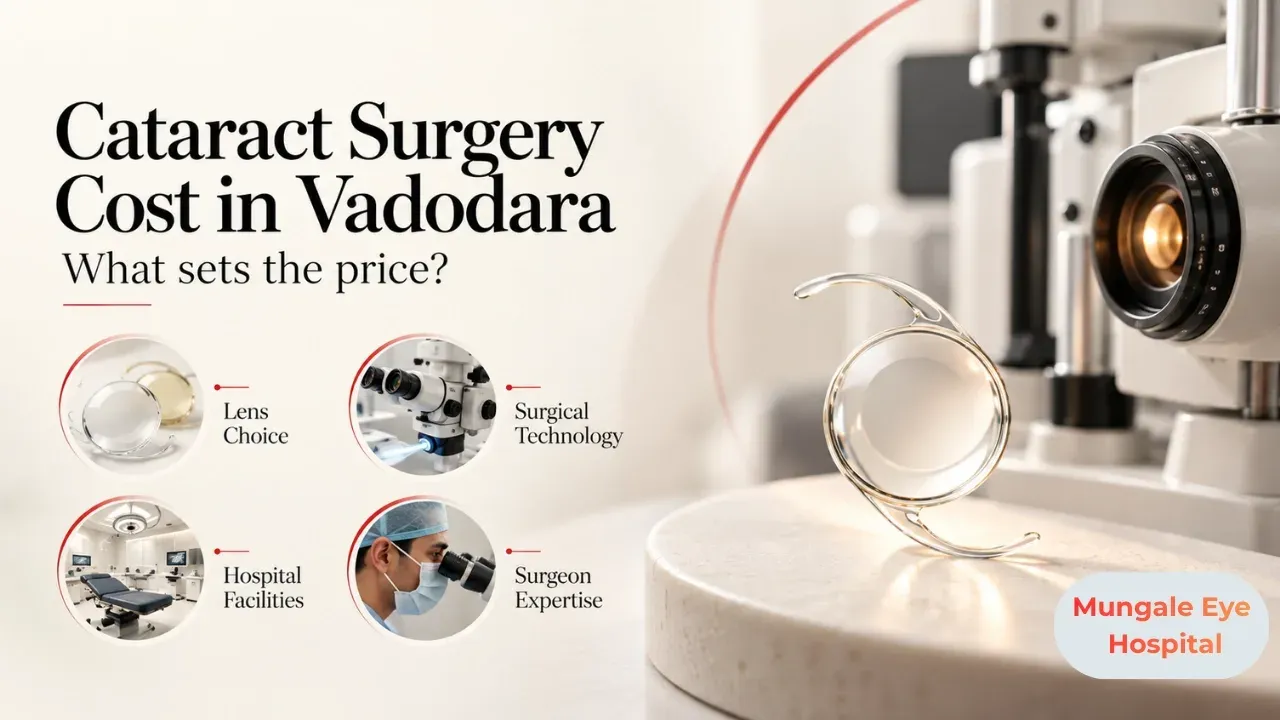
Ask three hospitals in Vadodara what cataract surgery costs and you may get three different answers. That is not necessarily a sign that someone is overcharging. The final figure depends on the lens that goes into your eye, the tests done beforehand, how the surgery is performed, where you stay and what aftercare is included. Once you know what each of those adds, an estimate stops being a mystery number and becomes something you can actually read.
What Decides the Cost of Cataract Surgery?
Which lens will be placed in the eye?
During surgery the cloudy natural lens is removed and an artificial intraocular lens (IOL) is placed in its position. The simplest and most commonly used type is the monofocal lens, which gives clear focus at one planned distance. Toric lenses can also correct astigmatism. Multifocal and extended depth-of-focus (EDOF) lenses try to give useful vision at more than one distance.
Prices differ across these types. So does suitability. A corneal or retinal problem, for instance, may rule out a lens that looks attractive on paper. And none of them can promise you will never need glasses again.
How is the surgery performed?
Most cataract operations now use phacoemulsification. Ultrasound energy breaks the cloudy lens into small pieces, which are then removed through a tiny opening. If the cataract is unusually dense or the eye has other complexities, the surgeon may need more time and preparation, and the estimate can reflect that.
What happens before the day of surgery?
The lens power is calculated from measurements of your own eye, so careful testing matters. You can expect checks of vision and glasses power, the cornea, eye pressure, the retina and the optic nerve. Some eyes need an extra scan. These tests are sometimes part of the package and sometimes billed on their own, so it is worth asking.
Where and how will you be treated?
Theatre charges, anaesthesia, medicines and room category all go into the total. Day-care and overnight stays are priced differently, and some hospitals offer a single package while others itemise everything.
Do other health issues change the plan?
They can. Glaucoma, diabetic eye disease, a scarred cornea, an earlier eye operation, uncontrolled blood pressure or blood sugar may all call for extra steps, such as a physician's clearance. Mention every condition and medicine at your first visit so the estimate does not change halfway through.
What Should a Good Estimate Look Like?
Get it in writing, and read it with a pen in hand. It should name the lens and say why it was suggested for you. It should tell you whether tests, medicines and follow-up visits are covered, and how many. It should also be honest about what is left out. A later laser procedure for a clouded lens capsule, for example, is usually separate.
Compare line against line instead of total against total. A lower headline figure that leaves out medicines and review visits may end up costing the same.
Will Insurance Cover It?
Many health policies cover cataract surgery, though the terms vary. Waiting periods, limits on eye procedures and approval from the insurer or TPA (third-party administrator) all play a part. One common surprise is that a policy pays only up to the cost of a standard lens. If you choose a premium lens, the difference comes from your pocket.
Mungale Eye Hospital offers insurance and cashless treatment support. Bring your policy papers to the consultation and ask the team to walk you through what is likely to be covered.
Does Paying More Mean Better Surgery?
Not by itself. A higher price may reflect a lens built for a particular need, but it does not make that lens right for every eye. Think about how you actually use your vision. A person who drives at night and reads for hours has different priorities from someone who mostly watches television at home. A good ophthalmologist will set out the choices without pushing the costliest, and will tell you plainly if a simpler option suits you well.
Key Takeaways
Final Thoughts
Wanting to know the cost before surgery is reasonable, and a good hospital will not mind the question. The best way to get a number you can trust is to have your eyes examined, because that is when your ophthalmologist can recommend a lens and plan the surgery. This article is general information and does not replace an in-person assessment.
If you would like the bigger picture first, our guide to cataract surgery covers symptoms, lens options, the procedure and recovery. When you are ready, you can book a consultation at Mungale Eye Hospital, Kothi (Anandpura), Vadodara.
Frequently Asked Questions
There is no standard figure, because the lens, technique, tests, facilities and follow-up all change the total. Any price quoted without examining your eye is only an approximation. After a proper eye check, the hospital can give you a written estimate based on what your eye needs.
Their estimates often cover different things. One may include tests, medicines and review visits, while another lists them separately. Lens brand, theatre charges and room category also vary. Comparing the itemised lines will tell you more than comparing the totals.
In many cases it is the largest variable. Monofocal, toric, multifocal and EDOF lenses are priced differently, and the right one depends on your astigmatism, eye health and daily routine. Your ophthalmologist can explain what each lens can and cannot do before you decide.
Many policies do, but the details differ. Waiting periods, sub-limits and insurer approval affect the amount paid, and some policies cover only a standard lens. Share your policy with the hospital's insurance desk before surgery so the team can explain what to expect.
Ask which lens is proposed and why, what the estimate includes and leaves out, how many follow-up visits are covered and what risks apply to your eye. If you are insured, ask how cashless approval works. A good team will be glad to answer all of this.
Sometimes. Additional reviews, extra medicines, or later treatment such as laser for a cloudy lens capsule may fall outside the original estimate. Asking about these in advance, and getting the answer in writing, avoids surprises.
Sources and further reading
Reviewed by
MBBS, MS (Ophthalmology) · Fellowship in Glaucoma, L V Prasad Eye Institute, Hyderabad
Gujarat Medical Council Reg. No. G-12281

MBBS, MS (Ophthalmology), DNB · Fellowship in Cornea & Anterior Segment, L V Prasad Eye Institute, Hyderabad
Gujarat Medical Council Reg. No. G-39262
Book a consultation
2nd Floor, Vinraj Plaza, opp. Government Press, Kothi Road, Anandpura, Vadodara, Gujarat 390001
Mon - Sat, 09:00 AM - 08:00 PM · Sunday closed
Related Articles
Start with a conversation.
Appointments
+91 81400 50055