
In this article
- What Exactly is AI in Eye Care?
- Key AI capabilities in eye care:
- Where AI is Making the Biggest Difference: 5 Key Areas
- 1. Diabetic Retinopathy: AI Saving Millions of Indian Eyes
- 2. Glaucoma: Detecting the Silent Thief Before It Strikes
- 3. Age-Related Macular Degeneration (AMD): Smarter Monitoring
- 4. Childhood Myopia: Predicting Who Will Develop High Power
- 5. Cataract Surgery: Precision Planning with AI
- AI in India: The National Push
- AI + Doctor: Better Together
- What AI does better than humans:
- What doctors do that AI cannot:
- What AI-Powered Eye Care Looks Like for You Today
- The Honest Limitations: What AI Still Can’t Do
- The Bottom Line: AI is Making Eye Care Better for Every Indian
Medically reviewed by Dr. Sachin Mungale, MBBS, MS (Ophthalmology) · Fellowship in Glaucoma, L V Prasad Eye Institute, Hyderabad · Gujarat Medical Council Reg. No. G-12281 and Dr. Meeta Mungale, MBBS, MS (Ophthalmology), DNB · Fellowship in Cornea & Anterior Segment, L V Prasad Eye Institute, Hyderabad · Gujarat Medical Council Reg. No. G-39262 · Reviewed on 3 October 2026
Published 25 February 2026
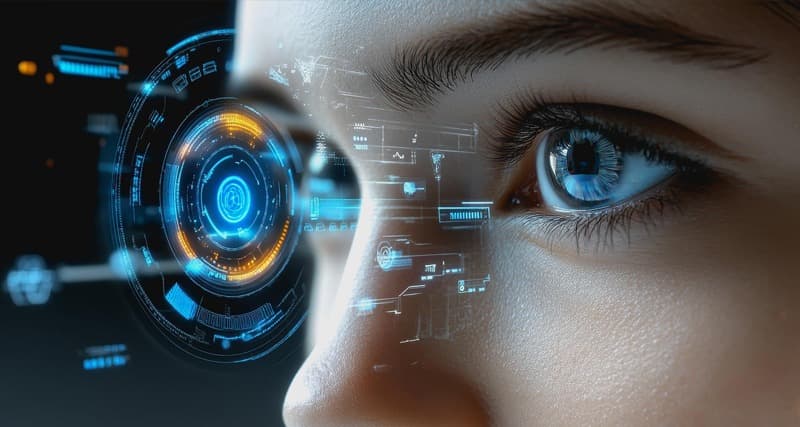
Imagine a machine scanning your retina in seconds and detecting a disease your doctor hasn’t noticed yet. This isn’t science fiction - it’s happening right now in hospitals and eye clinics across India and the world.
Artificial Intelligence (AI) is rapidly transforming ophthalmology. In fact, a 2025 survey found that 78% of ophthalmologists identified AI as the single most transformative trend in eye care today (Source: Ophthalmology Times, 2025). From detecting diabetic retinopathy before symptoms appear to predicting glaucoma progression years in advance, AI is making eye care smarter, faster, and more accessible than ever - especially for India’s 1.4 billion people.
Here’s everything you need to know about how AI in eye care is changing the way your eyes are examined and treated in 2026.
What Exactly is AI in Eye Care?
AI in ophthalmology refers to computer algorithms trained on millions of eye images and patient data to recognize patterns, detect diseases, and assist doctors in making better clinical decisions. The most important technology driving this revolution is deep learning -specifically Convolutional Neural Networks (CNNs), which can analyze retinal photographs, OCT scans, and fundus images with remarkable precision.
Think of it this way: A human ophthalmologist develops expertise by examining thousands of eyes over a career. An AI system learns from millions of images in months - identifying subtle patterns invisible to the human eye.
Key AI capabilities in eye care:
Where AI is Making the Biggest Difference: 5 Key Areas
1. Diabetic Retinopathy: AI Saving Millions of Indian Eyes
India has 77 million diabetics—the second largest diabetic population in the world. Diabetic retinopathy (DR), which damages retinal blood vessels, is the leading cause of blindness in working-age Indians. The tragedy? It’s almost entirely preventable with early detection. The AI breakthrough: Deep learning systems trained on hundreds of thousands of retinal photographs can now detect diabetic retinopathy with extraordinary accuracy.
What this means for Indian patients: AI-powered fundus cameras can now be deployed at primary health centres and diabetic clinics without a specialist present. A diabetic patient in rural Gujarat or rural Maharashtra can get a reliable retinopathy screening with results instantly reviewed by AI and flagged for urgent referral. The impact: Early AI-detected treatment can prevent blindness in up to 95% of diabetic retinopathy cases (Source: WHO screening guideline evidence base, PMC)
2. Glaucoma: Detecting the Silent Thief Before It Strikes
As discussed in our January blog, glaucoma is called the “silent thief of sight” because it causes no symptoms until significant vision is lost. AI is changing this. Machine learning models now analyse optic nerve head images and visual field test data to:
AI accuracy for glaucoma detection: Studies show AI models detect keratoconus (a related corneal condition) with sensitivity exceeding 98% and accuracy of 99.6% (Source: PMC review, January 2025–March 2025, covering PubMed studies) For India, where 90% of glaucoma cases go undiagnosed, AI-powered mass screening programmes could save millions from preventable blindness.
3. Age-Related Macular Degeneration (AMD): Smarter Monitoring
AMD is the leading cause of vision loss in people over 60 globally. AI is now used to:
Real impact: AI can predict visual prognosis after 12 months in AMD patients receiving injections helping doctors personalise treatment schedules and avoid unnecessary procedures (Source: AI in ophthalmology clinical pathway study, PMC)
4. Childhood Myopia: Predicting Who Will Develop High Power
India is experiencing a myopia epidemic among children, driven by increased screen time, reduced outdoor activity, and genetic factors. AI is now helping predict and manage this early. AI tools for myopia management:
Why this matters for Indian parents: Starting myopia management at age 8-10 based on AI prediction can prevent a child from developing dangerously high prescriptions that increase retinal detachment risk later in life.
5. Cataract Surgery: Precision Planning with AI
AI is improving cataract surgery outcomes by making IOL (lens) power calculations far more accurate than traditional formulas.
AI in India: The National Push
India’s government is actively advancing AI in healthcare. Following the IndiaAI Mission in 2024, NITI Aayog launched “AI for Vikshit Bharat” in September 2025 -a national initiative to leverage AI across healthcare, including ophthalmology (Source: Indian Journal of Ophthalmology, PMC, December 2025).
Key Indian AI developments:
AI + Doctor: Better Together
It’s important to address a common fear: Will AI replace eye doctors? The answer, clearly, is no. AI is a powerful tool, not a replacement. Here’s why:
What AI does better than humans:
What doctors do that AI cannot:
The most thoughtful voices in ophthalmology emphasize that clinicians should engage with AI, contribute to its development, and integrate it thoughtfully into practice as a valuable adjunct to clinical expertise - not a replacement for it.
The ideal model: AI handles the screening and pattern recognition. Your doctor interprets the results, makes the diagnosis, and designs your treatment plan.
What AI-Powered Eye Care Looks Like for You Today
When you visit a modern eye hospital in 2026, AI may already be working behind the scenes: At screening: AI analyses your fundus photograph as it’s taken, flagging any abnormalities for the doctor to review During diagnosis: OCT scans are automatically segmented and measured by AI, saving time and improving accuracy For cataract planning: AI calculates your optimal IOL power for the clearest vision after surgery For monitoring: If you have glaucoma or diabetic retinopathy, AI tracks your test results over time and alerts your doctor if you’re worsening faster than expected For rural patients: AI-enabled tele-ophthalmology means patients in smaller cities and villages get specialist-level screening without travelling hundreds of kilometres
The Honest Limitations: What AI Still Can’t Do
Responsible reporting means acknowledging where AI has gaps: Bias in training data: AI trained primarily on one ethnic group’s eye images may be less accurate for others. Diverse Indian datasets are critical
The Bottom Line: AI is Making Eye Care Better for Every Indian
AI in ophthalmology is not a distant future concept it is happening right now, making a real difference for real patients across India.
Earlier detection of diabetic retinopathy, glaucoma, and AMD - before vision loss begins Better surgical outcomes through AI-guided IOL calculations Accessible screening reaching rural India where specialists aren’t available Personalised care based on your unique eye data Predictive monitoring for high-risk patients with chronic conditions
But here’s the key takeaway: AI works best when paired with a skilled, experienced eye care team. Technology opens the door - your doctor walks you through it.
Frequently Asked Questions (FAQs)
No. AI in eye care acts as a powerful screening and decision-support tool, not a standalone diagnostic system. AI analyses images and flags potential abnormalities – but a qualified ophthalmologist always reviews the findings, interprets them in the context of your full medical history, and makes the final diagnosis. Think of AI as a highly accurate assistant that helps your doctor catch things faster and more reliably, not as a replacement for medical expertise.
Yes, increasingly so. Hospitals like Aravind Eye Care System and L.V. Prasad Eye Institute have already implemented AI retinopathy screening in their programmes. The government s IndiaAI Mission and “AI for Vikshit Bharat” initiative (2025) are actively pushing AI adoption in healthcare nationwide. Private eye hospital chains are also integrating AI-assisted fundus cameras and OCT analysis tools. Rural deployment through tele-ophthalmology networks is expanding, though coverage is still uneven.
AI screening tools used in ophthalmology have demonstrated exceptional accuracy in clinical studies. For diabetic retinopathy, systems have achieved sensitivity above 90% and AUC scores of 0.99 on validation datasets. For keratoconus detection, AI achieves accuracy exceeding 99.6%. However, accuracy depends on image quality, the specific AI system used, and the population it was trained on. Results should always be reviewed by a qualified ophthalmologist, especially for any positive (disease detected) finding.
Not necessarily and in many cases, it should make eye care more affordable and accessible. AI allows faster screening of more patients with fewer specialist resources, reducing cost per patient in large programmes. For individual patients, AI-assisted diagnostics may not significantly increase consultation costs at most hospitals. The bigger impact is in rural and underserved populations, where AI-enabled tele-ophthalmology brings specialist-quality screening without the cost of travel or waiting for a specialist s visit.
Yes, this is one of the most exciting AI applications for Indian children. AI models integrating axial length measurements, current prescription, family history, and lifestyle data can predict myopia progression with remarkable precision. At leading eye hospitals, this helps doctors decide when to start myopia control treatments (such as low-dose atropine drops or orthokeratology lenses), which are most effective when started early. If your child s power is increasing rapidly, ask your ophthalmologist about AI-assisted myopia progression assessment.
AI improves cataract surgery in two main ways. First, AI-based IOL power calculation formulas analyse your eye s detailed biometric measurements to recommend the most accurate lens power – reducing the chance of needing glasses after surgery. Second, AI assists in pre-surgical planning by flagging unusual eye anatomy that requires modified surgical technique. AI-assisted calculations achieve mean absolute errors below 0.30 diopters, significantly better than older formulas, meaning more patients see clearly without glasses after surgery.
Absolutely yes. If you have diabetes, annual dilated eye exams are essential and AI-assisted retinal screening is an excellent addition. AI analyses your retinal photographs systematically and consistently, catching early microaneurysms, haemorrhages, and other DR changes that can be subtle. Many diabetic eye screening programmes now use AI as a first-pass screening tool. Early AI-detected diabetic retinopathy treated promptly can prevent blindness in up to 95% of cases. Discuss this with your ophthalmologist at your next appointment.
Reviewed by
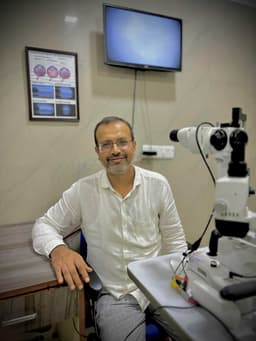
MBBS, MS (Ophthalmology) · Fellowship in Glaucoma, L V Prasad Eye Institute, Hyderabad
Gujarat Medical Council Reg. No. G-12281
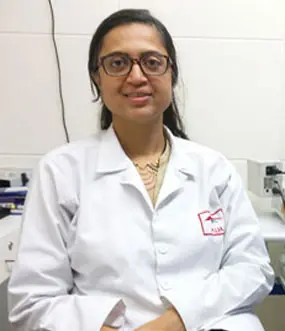
MBBS, MS (Ophthalmology), DNB · Fellowship in Cornea & Anterior Segment, L V Prasad Eye Institute, Hyderabad
Gujarat Medical Council Reg. No. G-39262
Book a consultation
2nd Floor, Vinraj Plaza, opp. Government Press, Kothi Road, Anandpura, Vadodara, Gujarat 390001
Mon - Sat, 09:00 AM - 08:00 PM · Sunday closed
Related Articles
Start with a conversation.
Appointments
+91 81400 50055