
Medically reviewed by Dr. Sachin Mungale, MS (Ophthalmology) · Glaucoma Fellowship, LVPEI · Gujarat Medical Council Reg. No. G-12281 and Dr. Meeta Mungale, MS (Ophthalmology), DNB · Cornea Fellowship, LVPEI · Gujarat Medical Council Reg. No. G-39262 · Reviewed on 3 October 2026
Published 30 September 2026 · Updated 30 September 2026
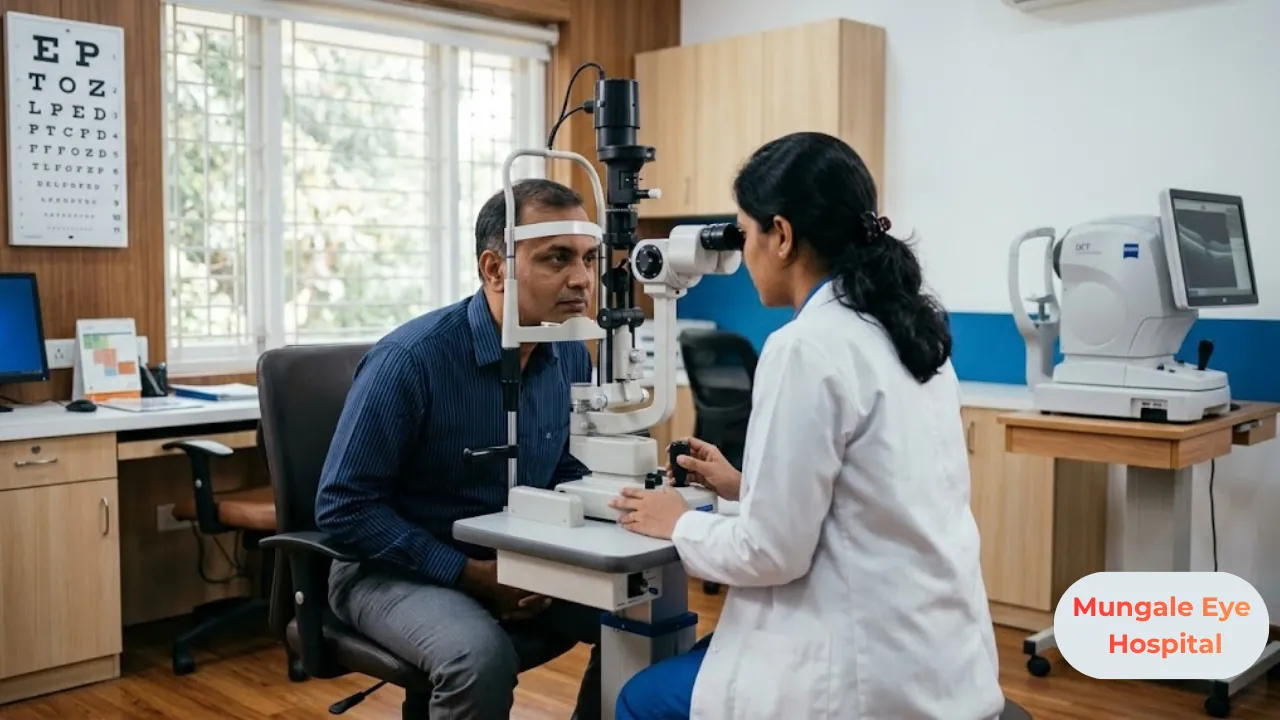
A complete eye check-up after 40 is a full examination by an ophthalmologist. It checks how well you see, and it also looks at your eye pressure, the lens, the optic nerve and the retina. Most adults should have one at around 40 even if their eyesight feels normal, because glaucoma and early diabetic eye changes rarely give any warning in their early years.
Turning 40 doesn't flip a switch. Your eyes won't go bad overnight. But this is roughly the decade when the small print on a medicine strip gets harder to read, when many people first hear that their sugar or blood pressure is high, and when a handful of eye conditions quietly become more common.
Below, we go through what happens during a complete eye exam, what each test is looking for, how often you should go back, the problems ophthalmologists most often find in people over 40, and the symptoms that shouldn't wait for a routine appointment.
Quick Answer
A comprehensive eye exam after 40 usually covers a letter chart test, a check of your glasses power, a reading-vision check, an eye pressure test, a microscope examination of the front of the eye, and a look at the retina after the pupils are dilated. If something needs a closer look, the doctor may add an OCT scan or a visual field test.
For adults with no symptoms or risk factors, guidance from the American Academy of Ophthalmology suggests a baseline exam at 40, then one every 2 to 4 years until 54, every 1 to 3 years from 55 to 64, and every 1 to 2 years after 65. People with diabetes, high blood pressure or a family history of glaucoma generally need to go more often.
Why Does Eyesight Change After 40?
Inside your eye sits a small, clear lens. When you're young it changes shape easily, which is how you switch focus from the road ahead to the phone in your hand. With age the lens gets stiffer. Near focus slowly becomes harder, and somewhere in the early or mid forties most people catch themselves holding a menu further away than they used to. Doctors call this presbyopia.
Age also raises the odds of glaucoma, cataract and age-related macular degeneration. Midlife is often when diabetes and high blood pressure are first diagnosed too, and both affect the tiny blood vessels at the back of the eye.
Then there's the tear film, the thin layer of moisture that coats the front of the eye. It tends to thin out as we get older, and long days on a laptop make things worse. Gritty, tired eyes by evening are one of the most common complaints in this age group.
My eyesight seems fine. Do I still need a check-up?
Probably, yes. Sharp vision only tells you that light is focusing properly. It says nothing about your optic nerve or eye pressure, and it won't reveal early diabetic changes in the retina.
Glaucoma shows why this matters. It usually wears away side vision first, and the brain fills in the gaps so well that people rarely notice. By the time they do, a fair amount of nerve damage may already have happened, and that damage generally can't be reversed. A baseline exam at 40 is meant to find it long before then.
What Happens During a Complete Eye Check-Up?
An eye test at an optical store is mostly about your glasses power. A comprehensive exam with an ophthalmologist covers the whole eye, from the cornea at the front to the retina at the back. The visit usually runs in roughly this order.
It starts with a few questions
You'll be asked about any changes you've noticed, your general health (diabetes, blood pressure and thyroid problems in particular), the medicines you take, any past eye surgery or injury, and whether anyone in the family has had glaucoma or lost vision early.
That last question isn't small talk. A parent or sibling with glaucoma changes how closely your eye pressure and optic nerve will be watched.
Reading the letter chart (visual acuity)
You cover one eye and read rows of letters that keep getting smaller. This measures distance vision. A small handheld card does the same thing at reading distance, and it's usually where presbyopia shows up first.
Checking your glasses power (refraction)
An automated machine often gives a starting reading. The power is then fine-tuned by asking you to compare lenses. Yes, the famous "one or two?" part.
After 40 this often turns up a need for reading glasses. A distance power that keeps changing from year to year can sometimes hint at an early cataract, so tell your doctor if you've been changing glasses often.
Measuring eye pressure (tonometry)
Tonometry measures intraocular pressure, which simply means the fluid pressure inside the eye. High pressure is one of the main risk factors for glaucoma.
Some clinics use a machine that blows a soft puff of air at the eye. Others use applanation tonometry, where a drop numbs the eye and a small probe touches the surface for a second or two. It sounds worse than it is. Neither method hurts, and applanation is generally the more precise one.
A normal reading is reassuring, but it doesn't fully rule glaucoma out. Some people develop glaucoma at pressures in the normal range. That's why the doctor also looks directly at the optic nerve.
The slit-lamp examination
A slit lamp is a microscope with a thin, bright beam of light. You rest your chin on a support while the doctor looks at your eyelids, the white of the eye, the cornea (the clear dome at the very front), the iris and the lens, all under magnification.
Early cataract, dry eye, pterygium (a fleshy growth that can creep onto the cornea) and corneal problems are usually picked up here. The doctor can also get a sense of the drainage angle, the spot where fluid leaves the eye, which matters for one type of glaucoma.
Dilating the pupils to see the retina
Drops are put in to widen the pupils. After a short wait, the doctor gets a clear view of the retina, the light-sensitive layer lining the back of the eye, and of the optic nerve. Diabetic retinopathy, blood pressure changes, early macular degeneration, retinal tears and glaucoma-related nerve changes all show up here.
For a few hours afterwards, reading will be blurry and bright light will feel harsh. Bring sunglasses, and don't plan on driving yourself home.
Extra tests, if you need them
Depending on what the basic exam shows, and on your age and risk factors, the ophthalmologist may suggest further tests. They aren't done on everyone.
Which Eye Tests Are Done After 40, and What Do They Show?
| Test | What it measures | What it can help find | Usually done |
|---|---|---|---|
| Visual acuity | How sharply you see at distance and near | Refractive errors, presbyopia, loss of vision from any cause | For everyone |
| Refraction | Your exact glasses power | Short-sightedness, long-sightedness, astigmatism, presbyopia | For everyone |
| Tonometry | Pressure inside the eye | Glaucoma risk, raised eye pressure | For everyone over 40 |
| Slit-lamp exam | The front of the eye under magnification | Cataract, dry eye, corneal disease, pterygium | For everyone |
| Dilated fundus exam | Health of the retina and optic nerve | Diabetic retinopathy, macular degeneration, retinal tears, glaucoma changes | For most adults over 40 |
| OCT (Optical Coherence Tomography) | Detailed layer-by-layer scan of the retina and optic nerve | Early glaucoma damage, macular swelling, macular degeneration | When the doctor needs a closer look |
| Visual field test (perimetry) | Side vision | Glaucoma-related vision loss, some nerve conditions | For glaucoma suspects and patients |
| Gonioscopy | The eye's drainage angle | Risk of angle-closure glaucoma | When the angle looks narrow |
| Pachymetry | Thickness of the cornea | Helps interpret pressure readings; corneal assessment | During glaucoma or cornea evaluation |
What is an OCT scan, and does it hurt?
It doesn't hurt at all. OCT, short for Optical Coherence Tomography, uses light to build detailed cross-section pictures of the retina and optic nerve. You look at a small target light for a few seconds and nothing touches your eye.
The scan can pick up thinning of the nerve fibre layer, one of the earliest signs of glaucoma, sometimes before your vision has changed at all. It's also used to find and track fluid or swelling in the macula, the small central patch of retina you rely on for reading and recognising faces.
What is a visual field test?
This one checks how much you can see out of the corners of your eyes while looking straight ahead. You fix your gaze on a point inside a bowl-shaped machine and click a button each time a faint light flickers somewhere off to the side.
It takes a few minutes per eye and needs some concentration. Glaucoma usually affects side vision first, so this test sits at the centre of diagnosing it and tracking it over the years.
How Often Should You Get Your Eyes Checked After 40?
That depends on your age, your health, your family history and what earlier exams found. There isn't one schedule that suits everybody.
For adults with no symptoms and no particular risk factors, the American Academy of Ophthalmology's guidance is widely followed.
Who should go more often?
Your ophthalmologist may want to see you sooner if you:
If any of these sound like you, go by the schedule your own doctor gives you rather than the general one above.
What Eye Problems Are Common After 40?
Most of what turns up at this age is mild and easy to manage. A few conditions need regular follow-up.
Why do I need to hold my phone further away to read?
That's presbyopia, the gradual loss of near focusing that comes with age. It happens to nearly everyone and usually becomes noticeable in the early to mid forties.
You might find yourself stretching your arm out to read a message, turning on an extra light for a book, or getting headaches after a long stretch of close work. It isn't a disease. Reading glasses, bifocals, progressive lenses or some contact lens options handle it well, though the power usually needs updating every few years.
Why is my vision getting hazy? Could it be a cataract?
A cataract is a clouding of the natural lens inside the eye. Age-related cataracts often start forming after 40, even though many people won't notice them for years.
When they do, it tends to feel like looking through a slightly fogged window. Headlights glare at night, colours look washed out, and glasses never seem quite right for long. Early on, a new prescription may be all you need. Once the cataract begins to get in the way of reading, driving or work, surgery to replace the cloudy lens with an artificial one, called an intraocular lens or IOL, is the standard treatment.
Can I have glaucoma and not know it?
Yes. Glaucoma is a group of conditions that damage the optic nerve, often, though not always, in connection with raised eye pressure. The most common form, open-angle glaucoma, develops slowly and painlessly.
There's no cure yet, and nerve damage that has already happened generally stays. Treatment with drops, laser or surgery lowers eye pressure to slow or stop further loss. This is the single biggest reason ophthalmologists push for regular checks after 40.
Why do my eyes feel gritty and tired by evening?
Often it's dry eye, where the eyes either make too few tears or the tears dry up too fast. It gets more common with age, and screens, air conditioning, contact lenses and some medicines all make it worse.
Burning, redness and a sandy feeling are typical. So, oddly, is watering. Vision may blur and then clear when you blink. Lubricating drops and a few changes in daily habits usually help, and there are further treatments if they don't.
Can diabetes affect my eyes if I still see clearly?
It can. Diabetic retinopathy is damage to the small blood vessels of the retina caused by diabetes, and its early stages usually cause no symptoms at all.
A yearly dilated exam lets these changes be found early. At that point, eye treatment where needed, along with good control of blood sugar, blood pressure and cholesterol with your physician, helps protect your sight.
Why do straight lines look wavy?
This can be a sign of age-related macular degeneration, or AMD, which affects the macula at the centre of the retina. It becomes more common after 50, and a family history or smoking raises the risk.
Early AMD may cause no symptoms. Later, central vision can blur, reading gets harder, and door frames or lines on a page may look bent. A retina examination and OCT scan help find and monitor it.
Are floaters normal after 40?
Mostly, yes. Small specks, threads or cobweb shapes drifting across your vision become more common as the gel inside the eye (the vitreous) changes with age. Floaters you've had for a long time that aren't changing are usually harmless.
A sudden burst of new floaters is a different matter, especially with flashes of light or a shadow in your vision. That needs urgent attention.
When Should You See an Eye Doctor Urgently?
Most eye symptoms can wait a few days for an appointment. Some can't.
Go the same day if you notice
These can point to a retinal detachment, an acute glaucoma attack or a serious infection. With each of them, how quickly treatment starts can affect how much vision is kept. Please don't wait for a routine slot.
Book an appointment soon if you notice
What to Expect on the Day of Your Eye Check-Up
How long does it take?
Plan on one to two hours. A good part of that is waiting for the dilating drops to work. If you need an OCT scan or a visual field test, the visit may run longer, or those tests may be booked for another day.
What should I bring?
If you wear contact lenses, call ahead and ask whether to take them out before the visit.
Does dilation hurt?
No. The drops can sting for a few seconds. Afterwards, bright light feels uncomfortable and close-up vision stays blurry for a few hours. It wears off on its own.
How Much Does an Eye Check-Up Cost, and Will Insurance Pay for It?
The cost depends on which tests you need. A standard comprehensive exam costs less than one that adds OCT, a visual field test or other specialised investigations, and the final bill depends on your findings and the facility.
Many standard health insurance policies in India don't cover routine eye check-ups unless the plan includes OPD or annual health check benefits. Tests linked to a diagnosed condition, and surgeries such as cataract surgery, are covered more often, depending on your policy. It's a good idea to check with your insurer, or with the hospital's insurance desk, before you go. Mungale Eye Hospital offers insurance and cashless support for eligible procedures.
Myths About Eye Check-Ups After 40
"I can read the chart, so my eyes must be healthy."
The chart measures sharpness and nothing else. Glaucoma, early diabetic retinopathy and early macular changes can all be present while you read the bottom line with ease.
"Pharmacy reading glasses are good enough."
Ready-made readers can help with presbyopia. They can't check your eye pressure, your optic nerve or your retina. They also don't correct astigmatism or a different power in each eye. Relying on them for years without an exam can delay the diagnosis of other problems.
"Glaucoma is always painful."
Most glaucoma causes no pain at all. The painful kind, acute angle-closure glaucoma, is far less common. The slow, silent form is exactly what routine exams are designed to catch.
"A cataract has to ripen before it can be removed."
That's an old idea. These days, cataract surgery is usually considered once the cataract starts affecting everyday life. Your ophthalmologist will talk you through the timing based on your vision and the health of your eye.
"You only need an eye exam when something's wrong."
Several of the most important eye conditions in midlife develop without symptoms. Regular exams are how they get found in time.
Mistakes People Often Make in Their Forties and Fifties
Simple Habits That Help Protect Your Eyes
A Few Practical Tips
Keep all your eye reports together in one file or folder. Pressure readings, OCT scans and visual field results mean the most when they can be compared across visits, and a change between two exams often tells the doctor more than any single result.
Mention every medicine you take, not only eye drops. Some steroids, allergy tablets, antidepressants and bladder medicines can affect eye pressure or other parts of the eye.
Check each eye on its own now and then. Plenty of people only discover a problem in one eye when they happen to cover the other. Reading a wall clock across the room with one eye closed, then the other, takes ten seconds.
And ask questions at your visit. Is my eye pressure normal? Does my optic nerve look healthy? When should I come back? You're entitled to understand your own results.
Choosing Where to Get Your Eye Check-Up
A comprehensive eye exam is most useful when an ophthalmologist, a medical doctor trained in eye disease and eye surgery, carries it out or reviews it. An ophthalmologist can read your results against your overall health, decide which further tests make sense, and treat whatever is found.
When you're choosing a hospital or clinic, look for qualified ophthalmologists who review results personally, equipment for eye pressure testing, retina examination, OCT and visual fields, experience with cataract and glaucoma, the ability to follow you up over the years, and doctors who explain things clearly.
At Mungale Eye Hospital in Kothi (Anandpura), Vadodara, comprehensive eye examinations are led by Dr. Sachin Mungale, MS (Ophthalmology), and Dr. Meeta Mungale, MS (Ophthalmology), DNB. The hospital provides diagnosis and care for cataract, glaucoma and cornea conditions, along with routine eye exams and long-term monitoring for chronic eye disease.
What's New in Eye Screening?
Eye diagnostics have become far more detailed over the past decade or so, without becoming more uncomfortable. OCT imaging now lets doctors study individual layers of the retina and optic nerve in a scan that takes seconds and never touches the eye.
Researchers are also developing artificial intelligence tools that screen retinal photographs, particularly for diabetic retinopathy. These are meant to support the ophthalmologist, not replace the exam. For most people, the basic advice stays the same. A thorough, regular examination is still the most dependable way to look after your sight.
Key Takeaways
Final Thoughts
Your eyes do change after 40, and most of those changes are easy to live with. Reading glasses, an updated prescription and a few good habits cover much of what this decade brings. A complete check-up earns its place by finding the quieter problems, early glaucoma or retinal changes, while they're still simple to monitor and treat.
If you're past 40 and have never had a comprehensive eye exam, or it's been several years since your last one, now is a sensible time to book. And if your vision ever changes suddenly, get seen that same day.
This article is general health information and is not a substitute for an eye examination. Diagnosis and treatment should always be decided with a qualified ophthalmologist after an in-person assessment.
Book a comprehensive eye check-up at Mungale Eye Hospital, Vadodara. Our ophthalmologists will examine your eyes carefully, explain what they find in plain language, and tell you when you need to come back.
FAQ SECTION
Around 40 is the usual recommendation for a baseline comprehensive eye exam, even with no vision problems. It gives your ophthalmologist a reference point for your eye pressure, optic nerve and retina, so later changes are easier to spot. If you have diabetes, high blood pressure, a family history of glaucoma or any symptoms, go earlier and follow the schedule your doctor sets.
For people without risk factors, the American Academy of Ophthalmology suggests every 2 to 4 years from 40 to 54, every 1 to 3 years from 55 to 64, and every 1 to 2 years after 65. Diabetes, glaucoma risk or an existing eye condition usually means yearly visits or more. Your ophthalmologist will advise what suits your eyes.
No. An optical store test mostly measures your glasses power. A complete check-up with an ophthalmologist also measures eye pressure, examines the front of the eye under a slit lamp, and checks the retina and optic nerve, usually after dilating the pupils. That's how silent conditions such as glaucoma, diabetic retinopathy and early cataract are found.
Dilating drops widen the pupil so the doctor can see the retina and optic nerve properly. Without them, only a small part of the back of the eye is visible. Dilation helps reveal diabetic changes, retinal tears, macular problems and glaucoma-related nerve damage. Expect blurry reading vision and light sensitivity for a few hours, so bring sunglasses and don't drive yourself home.
Presbyopia, the loss of close-up focus, affects nearly everyone. Cataract, dry eye and glaucoma are also common in this age group. People with diabetes may develop diabetic retinopathy, and age-related macular degeneration becomes more frequent after 50. Many of these respond well to treatment or monitoring when they're picked up early through regular eye exams.
Yes, and that's one of the main reasons to have regular exams after 40. Eye pressure measurement, an optic nerve examination, OCT scanning and visual field testing can all detect glaucoma or signs of risk before you notice anything. Treatment can't restore nerve damage that has already happened, but starting early can slow or stop further loss.
Get seen the same day for sudden vision loss, a burst of new floaters with flashes, a curtain or shadow across your vision, severe eye pain with redness, headache or nausea, sudden double vision, or any injury or chemical splash to the eye. These can signal problems like retinal detachment or an acute glaucoma attack, where quick treatment helps save vision.
That depends on your policy. Many standard plans in India don't pay for routine eye check-ups unless they include OPD or annual health check benefits. Tests linked to a diagnosed eye condition, and procedures such as cataract surgery, are covered more often. Ask your insurer, or the hospital's insurance desk, to confirm what your plan includes before your appointment.