
Written by the Mungale Eye Hospital team
Medically reviewed by Dr. Sachin Mungale, MBBS, MS (Ophthalmology) · Fellowship in Glaucoma, L V Prasad Eye Institute, Hyderabad · Gujarat Medical Council Reg. No. G-12281 and Dr. Meeta Mungale, MBBS, MS (Ophthalmology), DNB · Fellowship in Cornea & Anterior Segment, L V Prasad Eye Institute, Hyderabad · Gujarat Medical Council Reg. No. G-39262 · Reviewed on 21 October 2026
Published 21 October 2026
Part of our guide: Eye Check-Up After 40: Tests, Frequency & Warning Signs
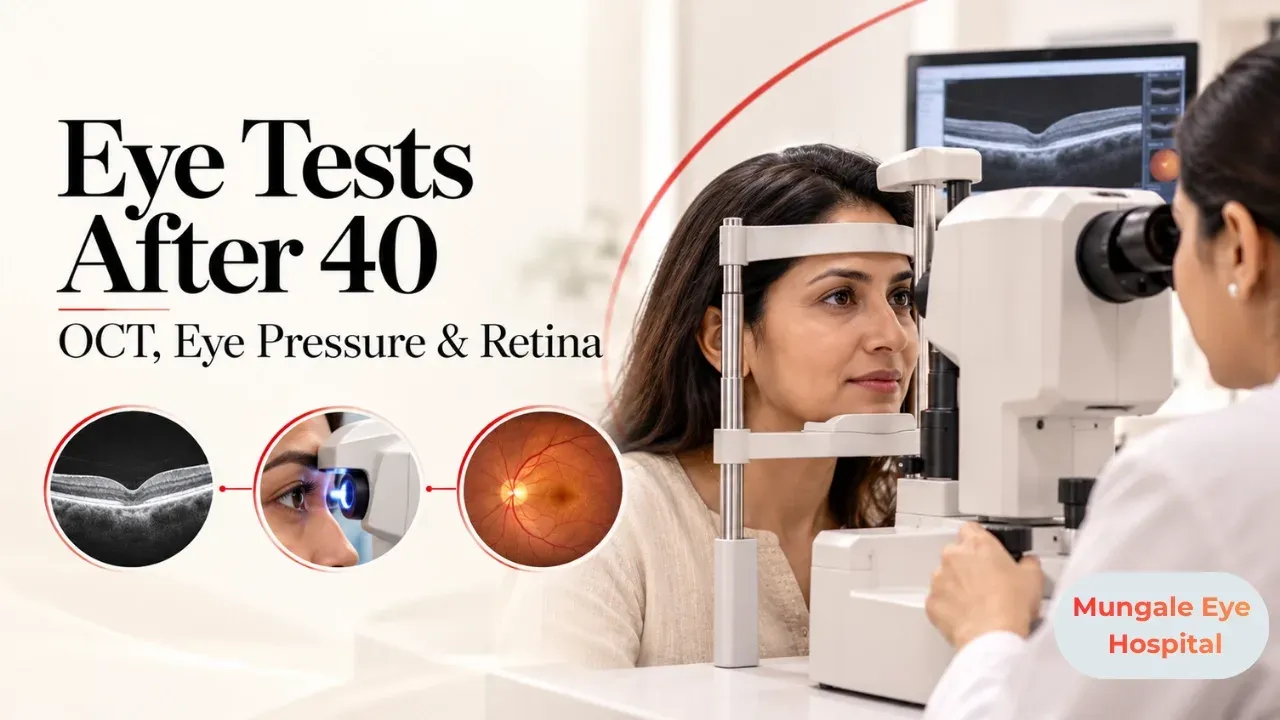
After 40, the risk of several eye conditions rises. Some are silent, so the right tests matter even when vision seems fine.
Why Tests Change After 40
Key Tests
Eye pressure check
High pressure is a risk factor for glaucoma, which can damage the optic nerve without symptoms.
Dilated retina examination
Lets the doctor check the retina, macula and optic nerve for disease.
OCT scan
A painless scan that makes detailed cross-sections of the retina and optic nerve.
Visual field test
Detects loss of side vision, often an early sign of glaucoma.
Refraction
Finds the right reading and distance glasses.
How Often?
Every one to two years is a common guide, and yearly with diabetes, glaucoma family history or other risks. Your doctor will advise.
Symptoms to Report
Key Takeaways
Final Thoughts
A few simple tests can protect your eyesight for the years ahead. For a thorough evaluation, you can consult Dr. Meeta Mungale at Mungale Eye Hospital in Vadodara.
Frequently Asked Questions
Yes. It uses light, not radiation, and is painless.
No. It needs eye pressure and optic nerve checks.
Not always. Your doctor decides based on your risk.
Glaucoma can still occur with normal pressure, so the nerve is also examined.
OCT and retina examination can pick up early changes.
Yes. Many problems begin silently.
Sources and further reading
Reviewed by
MBBS, MS (Ophthalmology) · Fellowship in Glaucoma, L V Prasad Eye Institute, Hyderabad
Gujarat Medical Council Reg. No. G-12281

MBBS, MS (Ophthalmology), DNB · Fellowship in Cornea & Anterior Segment, L V Prasad Eye Institute, Hyderabad
Gujarat Medical Council Reg. No. G-39262
Book a consultation
2nd Floor, Vinraj Plaza, opp. Government Press, Kothi Road, Anandpura, Vadodara, Gujarat 390001
Mon - Sat, 09:00 AM - 08:00 PM · Sunday closed
Related Articles
Start with a conversation.
Appointments
+91 81400 50055