
Written by the Mungale Eye Hospital team
Medically reviewed by Dr. Meeta Mungale, MBBS, MS (Ophthalmology), DNB · Fellowship in Cornea & Anterior Segment, L V Prasad Eye Institute, Hyderabad · Gujarat Medical Council Reg. No. G-39262 · Reviewed on 18 October 2026
Published 18 October 2026
Part of our guide: Laser-Assisted In Situ Keratomileusis (LASIK) Eye Surgery Types, Cost, Benefits and Who Qualifies
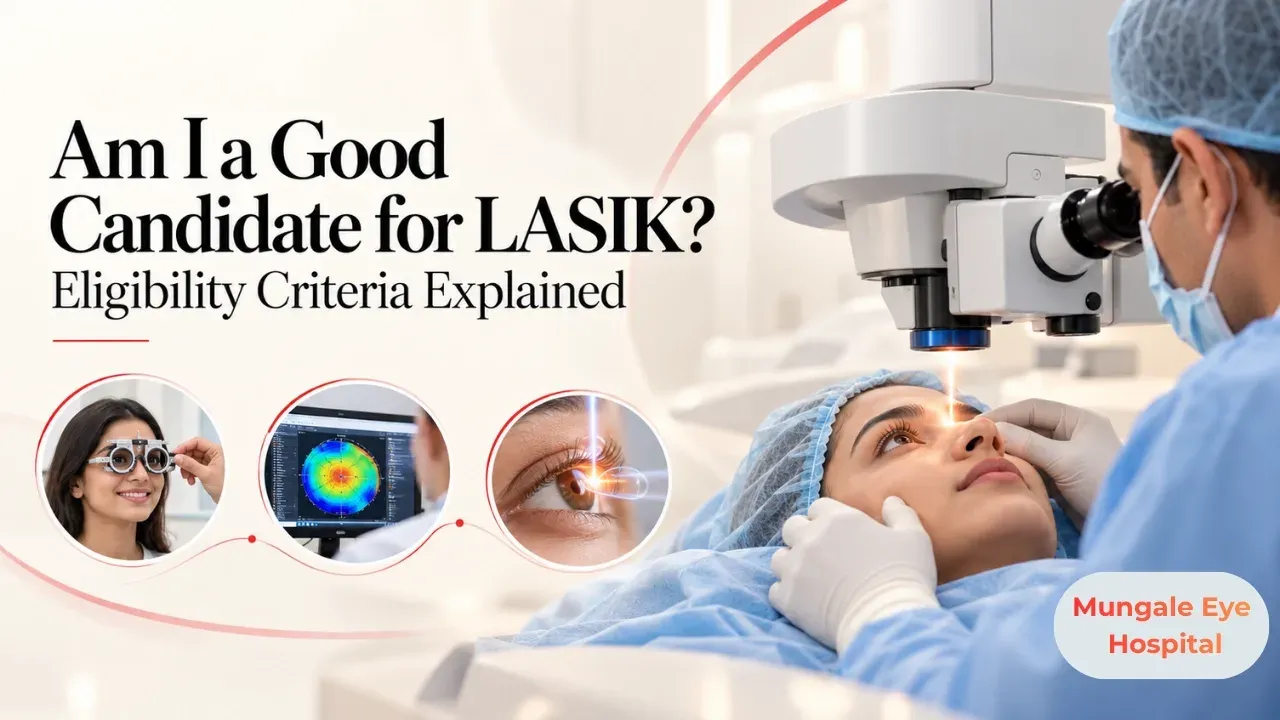
You may be a good candidate for LASIK if you are at least 18 years old, your glasses power has been stable for about a year, your corneas are healthy and thick enough, and you have no active eye disease or certain health conditions. The final answer comes only after detailed eye tests, because corneal shape and thickness matter as much as your power.
What Do Surgeons Check?
Age
Most surgeons advise LASIK from 18 years onward, once eye growth is complete. Many prefer patients in their early twenties or older.
Stable power
Your spectacle power should not have changed much for at least 12 months. Changing power suggests the eye is still developing.
Power range
LASIK treats myopia, hyperopia and astigmatism within certain limits. Very high powers may be better treated with other procedures.
Corneal thickness
The cornea must be thick enough to leave a safe amount of tissue after treatment. A pachymetry test measures this.
Corneal shape
Topography and tomography scans check for keratoconus or early irregular shapes. Doing LASIK on such corneas can weaken them further.
Dry eye
Existing dry eye should be treated first, because LASIK can make it temporarily worse.
Pupil size and night vision
Large pupils may raise the chance of glare or halos at night, which surgeons consider when planning.
General eye health
The retina, eye pressure and lens are checked to rule out other problems.
Who Is Usually Not Suitable?
What If You Are Not Suitable?
Not being a LASIK candidate does not mean you cannot be free of glasses. Options include:
How to Prepare for the Evaluation
Key Takeaways
Final Thoughts
A careful candidacy check is the most important step in safe vision correction. An honest assessment protects your eyes for decades. For a full pre-LASIK evaluation, you can consult Dr. Meeta Mungale, an ophthalmologist at Mungale Eye Hospital in Vadodara.
Frequently Asked Questions
Most surgeons perform LASIK from age 18, once eye power has been stable for at least a year. Many prefer patients in their twenties because the eyes are more likely to have stopped changing.
It depends on your corneal thickness and shape. Moderate high power may be treatable. Very high power or thin corneas may be better suited to ICL. Your surgeon will decide after tests.
Mild dry eye can often be treated before LASIK so surgery can go ahead safely. Severe dry eye may make LASIK unsuitable. SMILE or other options may be considered in some cases.
Contact lenses can temporarily change the shape of the cornea. Stopping them for the advised period lets the cornea return to its natural shape, giving accurate measurements for planning.
People with well-controlled diabetes and no diabetic eye disease may be considered. Uncontrolled diabetes can affect healing and vision stability, so surgery is usually delayed until control improves.
No. LASIK can weaken a cornea that is already thin and irregular. People with keratoconus may need cross-linking first, and may be offered other options such as ICL in selected cases.
Sources and further reading
Reviewed by
MBBS, MS (Ophthalmology), DNB · Fellowship in Cornea & Anterior Segment, L V Prasad Eye Institute, Hyderabad
Gujarat Medical Council Reg. No. G-39262
Book a consultation
2nd Floor, Vinraj Plaza, opp. Government Press, Kothi Road, Anandpura, Vadodara, Gujarat 390001
Mon - Sat, 09:00 AM - 08:00 PM · Sunday closed
Related Articles
Start with a conversation.
Appointments
+91 81400 50055