
In this article
Written by the Mungale Eye Hospital team
Medically reviewed by Dr. Meeta Mungale, MBBS, MS (Ophthalmology), DNB · Fellowship in Cornea & Anterior Segment, L V Prasad Eye Institute, Hyderabad · Gujarat Medical Council Reg. No. G-39262 · Reviewed on 18 October 2026
Published 18 October 2026
Part of our guide: Laser-Assisted In Situ Keratomileusis (LASIK) Eye Surgery Types, Cost, Benefits and Who Qualifies
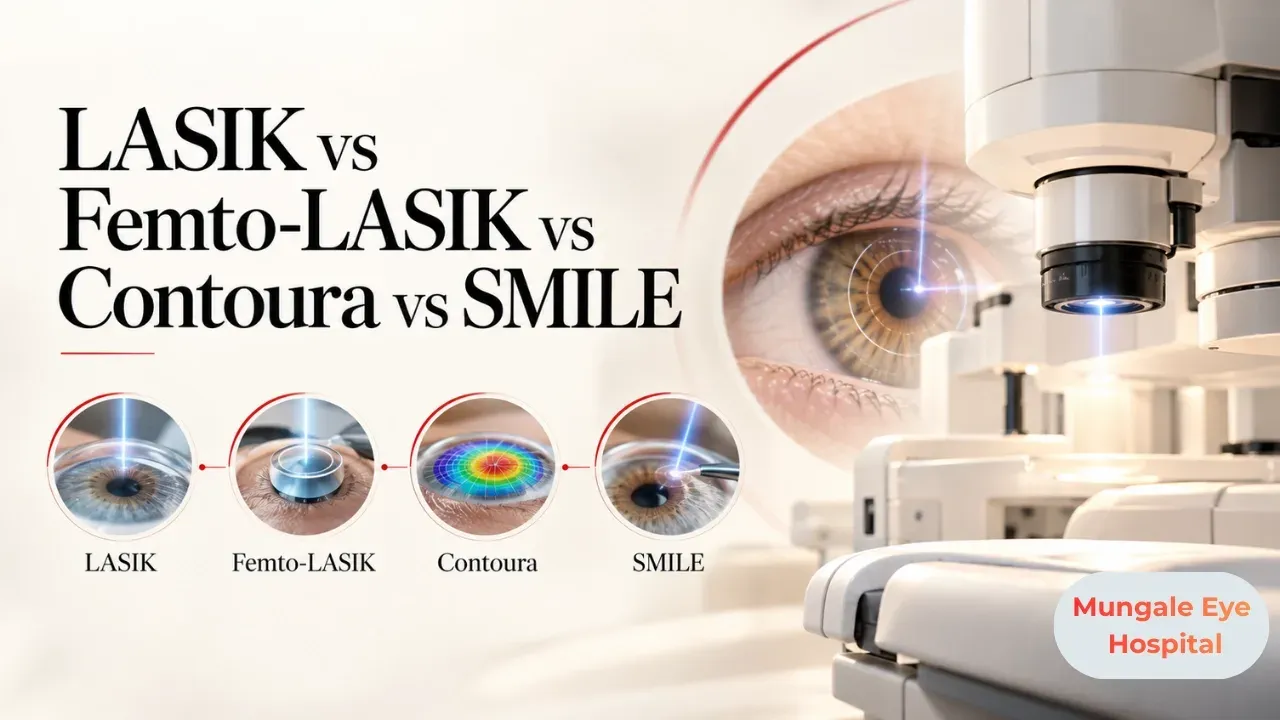
Standard LASIK, Femto-LASIK, Contoura Vision and SMILE are all laser procedures that reshape the cornea to reduce or remove the need for glasses. They differ in how the corneal flap or opening is made and how the laser treatment is planned. The best option depends on your power, corneal thickness and shape, dry eye status and lifestyle, not on which name sounds most advanced.
How Does Laser Vision Correction Work?
Myopia, hyperopia and astigmatism happen when the eye does not focus light sharply on the retina. Reshaping the cornea changes its focusing power so light focuses correctly. All four procedures aim to do this precisely and safely.
Standard LASIK (Microkeratome)
Femto-LASIK (Bladeless LASIK)
Contoura Vision (Topography-Guided LASIK)
SMILE (Small Incision Lenticule Extraction)
How Do They Compare?
Flap
LASIK, Femto-LASIK and Contoura create a flap. SMILE does not.
Recovery
LASIK and Contoura often give very quick early vision. SMILE vision may take a little longer to become crisp for some people.
Dry eye
All can cause temporary dry eye. SMILE may cause slightly less in the early phase.
Suitability
Contoura suits eyes with irregular surface patterns. SMILE suits many myopia patients, especially those in contact sports. Your tests decide which is safest.
What Determines Which One You Get?
Sometimes none of these is suitable, and options such as ICL or PRK are advised instead.
Key Takeaways
Final Thoughts
The right procedure is the one that fits your eyes, not the newest name on a brochure. A thorough evaluation gives a clear, honest recommendation. For a detailed refractive assessment, you can consult Dr. Meeta Mungale, an ophthalmologist at Mungale Eye Hospital in Vadodara.
Frequently Asked Questions
There is no single best procedure for everyone. The right choice depends on corneal thickness, shape, power, dry eye and lifestyle. A detailed pre-LASIK evaluation shows which option is safest and most suitable for your eyes.
Femto-LASIK makes the flap with a laser, which gives more predictable flap thickness. Both methods have good safety records in suitable patients. Your surgeon will choose based on your corneal measurements and experience.
Contoura uses a detailed map of the corneal surface to customise treatment. It may improve visual quality for eyes with small irregularities. It is not automatically better for everyone, so suitability is decided after testing.
SMILE may cause slightly less dry eye in the early months because it uses a small incision instead of a flap. Dry eye can still happen. Treating any existing dry eye before surgery is important with all methods.
Yes, all four can correct astigmatism within certain limits. Exact ranges depend on the laser platform and your eye measurements. Your surgeon will confirm whether your astigmatism can be treated safely.
Options such as PRK, ICL (implantable contact lens) or refractive lens exchange may be considered. Your eye specialist will discuss the safest alternative after evaluation.
Sources and further reading
Reviewed by

MBBS, MS (Ophthalmology), DNB · Fellowship in Cornea & Anterior Segment, L V Prasad Eye Institute, Hyderabad
Gujarat Medical Council Reg. No. G-39262
Book a consultation
2nd Floor, Vinraj Plaza, opp. Government Press, Kothi Road, Anandpura, Vadodara, Gujarat 390001
Mon - Sat, 09:00 AM - 08:00 PM · Sunday closed
Related Articles
Start with a conversation.
Appointments
+91 81400 50055