
Medically reviewed by Dr. Meeta Mungale, MS (Ophthalmology), DNB · Cornea Fellowship, LVPEI · Gujarat Medical Council Reg. No. G-39262 · Reviewed on 3 October 2026
Published 30 September 2026 · Updated 30 September 2026
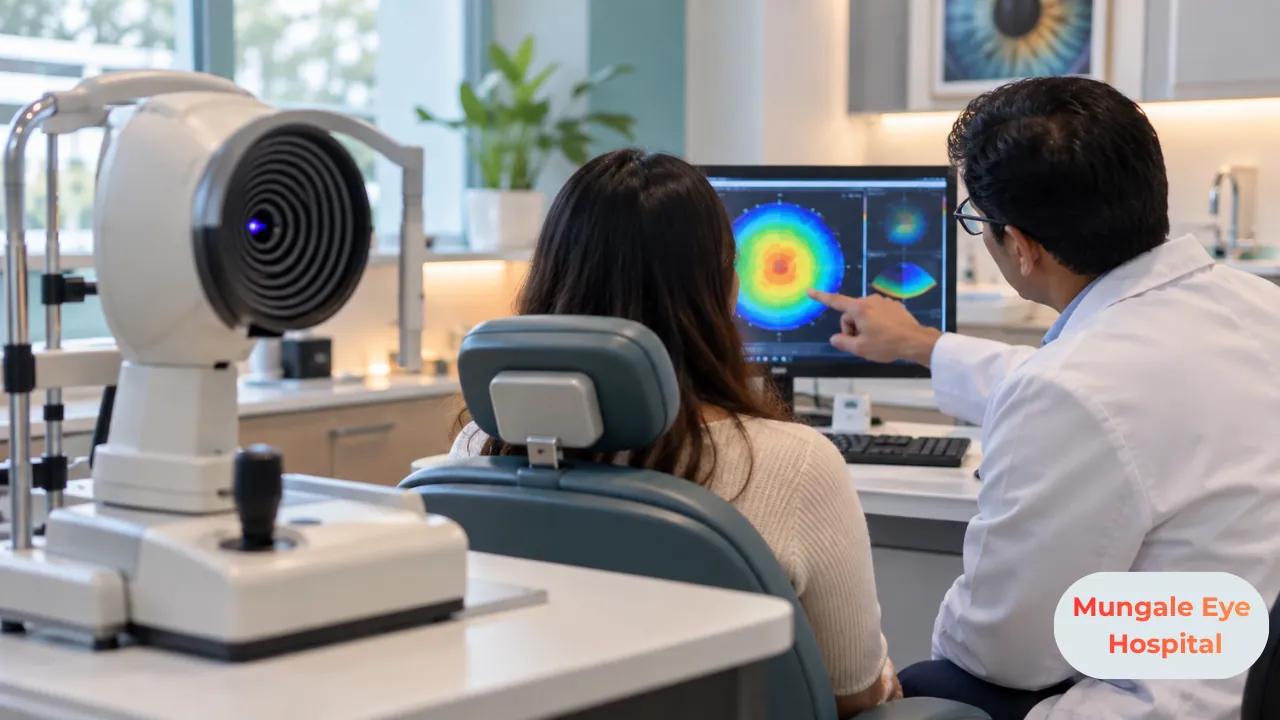
LASIK is a laser procedure that corrects short-sightedness, long-sightedness and astigmatism by changing the shape of the cornea, the clear window at the front of the eye. For people whose eyes are suitable, it can mean going through most of the day without glasses or contact lenses. Whether your eyes are suitable is something only a detailed examination can tell you, and that examination matters more than which laser you end up choosing.
Below we cover the different types of LASIK, what they cost in India, who tends to qualify, and what the weeks after surgery actually feel like.
Quick Answer
LASIK (Laser-Assisted In Situ Keratomileusis) uses a laser to reshape the cornea so that light focuses properly on the retina. The main versions are blade LASIK, bladeless Femto-LASIK, topography-guided Contoura Vision, flapless SMILE and surface-based PRK. You are usually a good candidate if you are over 18, your prescription has been steady for about a year, and your corneas are healthy and thick enough. In India, laser vision correction typically costs somewhere between Rs. 15,000 and Rs. 75,000 per eye, depending on the technique.
Why is choosing the right type of LASIK so important?
Nobody needs LASIK. People choose it because glasses fog up on a scooter ride, contact lenses sting after a long day at the laptop, or a job asks for good unaided vision. Since the surgery is optional, the bar for safety sits higher than it would for a procedure that treats disease.
The cornea is also something you cannot easily undo. Once tissue has been removed, it stays removed. An eye that already had a slightly weak or irregular cornea before surgery can become less stable afterwards, which is why a careful surgeon spends far more time studying your corneal scans than talking about packages.
Two people with exactly the same spectacle number can walk out of the same consultation with different advice. One may be told Femto-LASIK suits them well. The other may hear that PRK or a lens implant is safer, or that it is better to stay with glasses for now.
What is LASIK, and how does it change your vision?
Light entering the eye is bent into focus by the cornea and then by the natural lens behind it. If the curve of the cornea does not match the length of the eyeball, the image lands slightly in front of or behind the retina, and things look blurred. Eye doctors call this a refractive error.
With myopia, or short-sightedness, road signs and faraway faces go soft. Hyperopia, or long-sightedness, makes close work tiring and can blur distance vision as well. Astigmatism happens when the cornea is curved more like the back of a spoon than a round ball, so vision is smeared at every distance.
In LASIK, a very thin flap is lifted from the surface of the cornea. An excimer laser, which is a cool ultraviolet laser, then removes a tiny, precisely calculated amount of tissue underneath. The flap is laid back down and seals on its own without stitches. The new curve bends light to the right spot.
Things LASIK won't change
Somewhere around 40, almost everyone starts holding the phone a little further away to read it. That is presbyopia, a natural stiffening of the lens inside the eye, and LASIK does nothing to stop it. Cataract, a clouding of that same lens later in life, isn't prevented either. Someone who has LASIK at 25 will very likely reach for reading glasses in their mid-forties, just like everyone else.
What are the different types of LASIK?
People say "LASIK" for any laser eye surgery, but there are several separate techniques. They mostly differ in how the surgeon gets to the corneal tissue and how the laser pattern is planned.
Blade LASIK
The original version. A fine mechanical instrument called a microkeratome cuts the corneal flap, and the excimer laser does the reshaping. It has been used for decades and remains an option for people with low to moderate powers and normal corneas.
Femto-LASIK (bladeless LASIK)
The flap is made with a femtosecond laser instead of a blade. This laser fires extremely short pulses that separate tissue at a depth the surgeon sets in advance, so the flap is very consistent. Everything after that is the same as blade LASIK.
Contoura Vision
Contoura is a topography-guided treatment. Before surgery, a scanner maps thousands of points on your cornea and picks up small bumps and irregularities that a normal glasses prescription can't show. The laser treatment is then shaped around that map. Some people, especially those with slightly irregular corneas, may notice crisper vision with this approach. For others the difference is small, and your surgeon can tell you which group you are likely to fall into.
SMILE (Small Incision Lenticule Extraction)
SMILE skips the flap altogether. A femtosecond laser shapes a thin disc of tissue, called a lenticule, inside the cornea, and the surgeon draws it out through a cut only a few millimetres long. With no flap to protect, there are fewer restrictions in the weeks after surgery. It is mainly used for myopia, with or without astigmatism.
PRK (Photorefractive Keratectomy)
In PRK the surgeon gently clears away the thin skin on the surface of the cornea, called the epithelium, and applies the laser directly to the surface. No flap, no incision. It is often suggested for people with thinner corneas or those who box, play contact sports or work in jobs where a knock to the eye is likely. The trade-off is a rougher first few days, since that surface skin has to grow back.
ICL (Implantable Collamer Lens)
ICL isn't laser surgery at all. A soft, thin lens is placed inside the eye, just in front of your natural lens, and the cornea is left untouched. It is usually considered when the power is very high, when the cornea is too thin or irregular for a laser, or when laser correction has been ruled out for another reason.
How do the LASIK techniques compare on cost and suitability?
The figures below are indicative ranges reported across eye hospitals in India. They give a rough sense of how the options sit against each other and should not be read as a quote.
| Technique | What happens | Usually considered for | Indicative price per eye (India) | Typical recovery |
|---|---|---|---|---|
| Blade LASIK | Microkeratome cuts the flap, excimer laser reshapes the cornea | Low to moderate power, normal corneal thickness, healthy eye surface | Rs. 15,000 to Rs. 30,000 | Clearer within days, settles over a few weeks |
| Femto-LASIK | Femtosecond laser makes the flap, excimer laser reshapes | Much the same as blade LASIK | Rs. 25,000 to Rs. 45,000 | Similar to blade LASIK |
| Contoura Vision | Laser pattern built from a detailed corneal map | People wanting a customised treatment, some mild corneal irregularities | Rs. 40,000 to Rs. 65,000 | Similar to Femto-LASIK |
| SMILE | Thin tissue disc removed through a small cut, no flap | Moderate to higher myopia, with or without astigmatism | Rs. 45,000 to Rs. 75,000 | Fewer restrictions, many return to routine a bit sooner |
| PRK | Surface skin cleared, laser applied directly | Thinner corneas, contact-sport players, eyes unsuited to a flap | Rs. 18,000 to Rs. 35,000 | Sore for several days, vision sharpens over weeks |
| ICL | Lens placed inside the eye, cornea untouched | Very high power, thin or irregular corneas | Rs. 90,000 to Rs. 1,50,000 | Often clear within a few days |
What you finally pay depends on your test results, the machine used, the surgeon and the hospital. Ask for a written estimate once your evaluation is done.
What affects the price of LASIK in India?
A quick search throws up LASIK prices that are all over the place, and there are good reasons for that. The technique is the biggest factor, because SMILE and Contoura rely on more expensive equipment than blade LASIK. Some hospitals include the pre-surgery scans in the package while others bill them separately. Most quote per eye, so the total for both eyes is double. Medicines, protective glasses and follow-up visits may or may not be part of the headline figure. City and hospital make a difference too.
When two quotes look very different, lay them side by side and check what each one actually covers. A cheaper number that leaves out tests and follow-ups often ends up costing about the same.
Will my health insurance pay for LASIK?
Usually not. Most Indian health insurance policies treat LASIK as elective or cosmetic. A few policies do pay when the power is above a certain level, and the cut-off varies between insurers. Call your insurer or check your policy wording before you plan dates. The hospital's insurance desk can tell you which papers insurers normally ask for.
Am I a good candidate for LASIK?
This question gets settled in the examination room. Your spectacle number alone won't answer it. People who turn out to be good candidates tend to have a few things in common.
They are at least 18, and often a little older, since power can keep creeping up into the early twenties. Their prescription has barely moved for a year or more. Their corneas are thick enough that a safe layer of tissue will remain after treatment, and the scans show a smooth, regular shape with no hint of keratoconus. Dry eye is either absent or well under control. General health is stable. And they go in expecting to depend much less on glasses, which is a very different thing from expecting perfect vision in every light at every age.
When LASIK isn't advised
Keratoconus is the most important reason to say no. In this condition the cornea slowly thins and pushes forward into a cone shape, and taking tissue away from it can make it bulge further. Suspected or early keratoconus is treated with the same caution.
Other reasons to avoid LASIK or postpone it include corneas that are simply too thin, dry eye that hasn't been brought under control, an eye infection or inflammation, a power that is still changing, pregnancy or breastfeeding (hormones can shift the prescription for a while), uncontrolled diabetes, and some autoimmune conditions that slow healing. Eyes with glaucoma or cataract need those problems looked after first.
Hearing that LASIK isn't right for you can be disappointing. PRK, SMILE or an ICL may still be possible depending on the reason, and for some people good glasses or well-fitted contact lenses remain the best answer.
What tests are done before LASIK?
Set aside a few hours for the evaluation. None of the tests hurt, though the dilating drops will leave your vision blurry and light-sensitive for a while afterwards, so bring sunglasses and don't plan to drive.
Refraction pins down your exact power, often checked again after drops have relaxed the focusing muscles. Corneal topography or tomography maps the shape and height of the cornea and is the main way early keratoconus is caught. Pachymetry measures how thick the cornea is at different points. The doctor will also look at your tear film and eyelids to judge how well the surface of the eye will heal, measure your pupils to gauge the chance of night glare, check your eye pressure, and examine the retina at the back of the eye.
A cornea specialist looks especially hard at the topography and pachymetry results, since a subtle weakness hidden in those scans is the most common reason a keen LASIK candidate gets told to wait or choose something else. Corneal evaluation is a core specialty at Mungale Eye Hospital, where the diagnostic set-up includes corneal topography, pachymetry and anterior-segment imaging.
How should I prepare for LASIK?
Contact lenses slightly flatten or warp the cornea, so they need to come out well before your scans and your surgery. Soft lenses are usually stopped a week or two beforehand, and rigid gas-permeable lenses for longer. Your surgeon will give you exact dates.
Tell the team about every medicine you take, any allergies, diabetes, thyroid or autoimmune problems, earlier eye injuries or operations, and whether you are pregnant or breastfeeding. It can feel like oversharing. It isn't.
On surgery day, come without eye make-up, face cream or perfume. Someone else should take you home. If your work is heavy on screens, keep the next couple of days free if you can.
What happens on the day of surgery?
The thought of a laser near your eye is unsettling for most people, so it helps to know how the half hour actually goes.
You lie back and numbing drops go in. There are no injections and no general anaesthesia. A small clip holds your eyelids open, so blinking stops being something to worry about. Depending on the technique, the surgeon then makes the flap, clears the surface layer, or prepares the lenticule. You'll be asked to look at a small blinking light while the excimer laser works, and modern lasers follow tiny eye movements as you go. For LASIK, the flap is then smoothed back into place.
From start to finish it usually takes 15 to 20 minutes, while the laser itself runs for well under a minute per eye. Most people describe pressure rather than pain. Some notice their vision dim for a few seconds or catch a faint smell during the laser step. Both are expected.
What does LASIK recovery feel like?
The first day
Expect watering, a gritty feeling and some mild burning for a few hours, with hazy vision. Going home and sleeping helps a lot. Plenty of LASIK patients wake up the next morning surprised at how clearly they can see the clock. You'll normally be checked within a day or two.
The first week
Vision keeps clearing, though it may swing a little through the day. Dryness and glare from bright lights are common. Most people go back to office work within a few days, and taking frequent breaks from the screen makes those days easier.
The weeks that follow
Things carry on settling for several weeks. Halos around headlights at night, if you have them, usually fade during this period. PRK takes longer to reach its final sharpness, and in some eyes full stability can take a couple of months.
What should I avoid after LASIK?
Use your drops on time, exactly as prescribed. Don't rub your eyes, even when they itch, particularly while the flap is still settling. Sleep with the shield or protective glasses for as long as you've been told to.
Keep soap, shampoo and bath water out of your eyes. Stay out of swimming pools, dusty sites and smoky rooms for the period your surgeon advises, and hold off on eye make-up and contact sports until you get the all-clear. Sunglasses outdoors will cut glare while the eyes heal. And go to every follow-up, including the ones where you feel completely fine.
When to call your doctor straight away
Problems after LASIK are uncommon, but some signs shouldn't wait for your next appointment. Get in touch with your eye surgeon the same day if the pain is getting worse instead of better, your vision suddenly drops, the eye becomes redder or starts producing discharge, light begins to hurt more, or the eye takes any kind of knock.
What are the benefits of LASIK compared with glasses and contact lenses?
The obvious one is being able to get through most of the day without anything on your face or in your eyes. Driving, working, playing sport, travelling, waking up at night and actually seeing the room all become simpler. Most techniques give useful vision within a day or two.
Long-term contact lens wearers also leave behind the cleaning routine and the infection risk that comes with lenses. And the change to the cornea is permanent, even though the rest of the eye will keep ageing as normal. All of this holds only when the surgery was right for that eye to begin with.
What are the risks and side effects of LASIK?
LASIK has a long safety record in well-chosen patients, but you should go in knowing what can happen.
Dry eye is the side effect people notice most. It usually eases over weeks or months with lubricating drops, though it can linger, especially in people who had dry eyes before surgery. Glare, halos and starbursts around lights at night are fairly common early on and generally reduce with time.
Sometimes the correction lands a little short or a little over, and glasses for certain tasks or a second touch-up treatment may be needed if the cornea allows it. In some eyes a small amount of power slowly returns over the years, which is called regression. With LASIK specifically, the flap can wrinkle or shift, almost always after rubbing or an injury. Infection is rare, and your drops and hygiene routine are there to keep it that way.
The most serious complication is corneal ectasia, where the cornea weakens and bulges after surgery. It is rare, and careful screening for keratoconus and thin corneas beforehand is the best way to avoid it. Ask your surgeon to go through which of these risks are more or less relevant to your eyes.
What are some common LASIK myths?
"It's going to hurt a lot." Numbing drops mean most people feel pressure rather than pain. A few hours of soreness after LASIK is normal, and PRK can be uncomfortable for a few days.
"If you wear glasses, you can get LASIK." A large share of people who come in for LASIK turn out to be unsuitable because of thin corneas, corneal shape, dry eye or a changing power. Finding that out before surgery protects your eyes.
"I'll never wear glasses again." Reading glasses usually come back into the picture after 40, whether or not you had LASIK.
"The costliest option is the best one." The right technique is the one that fits your cornea and your power. A newer machine isn't automatically better for your particular eye.
"LASIK is the only way to get rid of glasses." PRK, SMILE and ICL each suit different eyes.
Mistakes people often make with LASIK
The most common one is picking a hospital by the lowest number on a poster without asking what it includes. Close behind is walking into the evaluation still wearing contact lenses, which can throw off the corneal measurements.
Some people leave out details like dry eye, allergies or an autoimmune condition because they seem unrelated. Others skip follow-ups once they can see well, or go back to the pool, the construction site or eye make-up a little too soon. And quite a few are caught off guard in their forties when reading glasses turn up anyway.
How do I choose an eye hospital for LASIK?
Before you commit, ask which tests will be done and who will read them. Ask why a particular technique is being suggested for your eyes, and what else could work. Find out exactly what the price covers, who will do the surgery, who will see you afterwards, and what happens if you need a touch-up or run into a complication.
A hospital that sometimes tells people "not for you" is usually one that takes corneal screening seriously.
What's new in laser vision correction?
Laser eye surgery has changed a great deal in the past twenty years. Femtosecond lasers made flap creation far more precise, SMILE gave people with myopia a flapless option, and topography-guided treatments like Contoura started treating the fine irregularities of the cornea alongside the glasses number. Corneal imaging has improved as well, so early thinning disorders are easier to catch before surgery. Even with all of this, choosing the right patient remains the thing that most affects safety.
A few tips before you book
Take your old glasses and any previous prescriptions with you, so the doctor can see whether your power has been stable. Think about how you use your eyes day to day, whether that's night driving, eight hours at a screen or weekend cricket, and mention it. If you're in your late thirties, ask how presbyopia will affect your result over the next ten years. If anyone has ever mentioned "thin corneas" or "irregular astigmatism" to you, ask directly whether keratoconus has been ruled out. Older patients may also want to ask about monovision, where one eye is set slightly for near work.
Habits that help LASIK go well
Get the full evaluation done, including topography, pachymetry and a dry-eye check. If your eyes are dry or your eyelids inflamed, have that treated before surgery. Stick to the drop schedule and the list of things to avoid. Keep every follow-up. And carry on with routine eye check-ups for the rest of your life, since LASIK doesn't replace screening for glaucoma, cataract or retinal disease.
Key Takeaways
Final Thoughts
For the right person, LASIK can take away a daily chore that most glasses and lens wearers have simply learned to live with. Today's range of techniques lets surgeons match the treatment much more closely to each eye. Still, what decides the outcome is mostly settled before anyone lies down under a laser, in the scans that show whether your cornea can take it and which approach suits it.
If you live in or around Vadodara and are thinking about life without glasses, a detailed eye and cornea evaluation at Mungale Eye Hospital will show you where you stand. Care is led by Dr. Sachin Mungale (MS, Ophthalmology) and Dr. Meeta Mungale (MS, Ophthalmology, DNB), and the hospital's focus on corneal assessment puts it right where every LASIK decision begins. Book a consultation to find out whether LASIK, another procedure or a different approach makes most sense for your eyes.
This article is for general information and does not replace an in-person eye examination. Please make any decision about diagnosis or treatment with a qualified ophthalmologist. Prices mentioned are indicative and vary with diagnosis, technique, technology, tests and individual needs.
FAQ SECTION
LASIK has been performed for decades and is considered safe for people who have been carefully screened. The pre-surgery scans, especially those measuring corneal thickness and shape, do most of the work in keeping it safe. Dry eye and night glare are the side effects people notice most, and both usually improve over the following weeks or months. Your surgeon should go through the risks that apply to your eyes.
Most surgeons consider LASIK from 18 onwards, and many prefer patients to be a little older because eye power often keeps changing into the early twenties. A steady prescription matters more than age itself, ideally with little or no change for about a year. The evaluation checks this stability along with the thickness and shape of your corneas before any decision is made.
Across India, laser vision correction generally ranges from around Rs. 15,000 per eye for blade LASIK to about Rs. 75,000 per eye for SMILE, with Femto-LASIK and Contoura falling in between. Your final cost depends on the technique, the tests you need, the equipment used and what the package covers. A written estimate after your evaluation is the most reliable figure to plan around.
None of them is best for everyone. SMILE avoids a flap, Contoura builds the treatment around a detailed map of your cornea, and Femto-LASIK makes a precise, consistent flap. Which one suits you depends on your power, corneal thickness and shape, the health of your tear film and your lifestyle. Some people are better served by PRK or an ICL instead.
During the procedure most people feel pressure rather than pain, because numbing drops are used and the laser step is very short. Afterwards the eyes often water, feel gritty or burn mildly for a few hours, and this usually settles by the next morning. PRK is more uncomfortable for a few days while the surface of the eye heals, and prescribed drops help during that time.
LASIK is generally avoided in keratoconus, a condition where the cornea thins and bulges forward. Removing tissue from an already weak cornea can make it less stable. People with keratoconus have other options, such as corneal cross-linking to slow its progress, specialised contact lenses including scleral lenses, or in some cases an implantable lens. A cornea specialist can advise on what suits each stage.
Most people need glasses far less after LASIK, but results differ from eye to eye. Some keep a pair for night driving, and a small amount of power can return over the years in some cases. LASIK also doesn't stop presbyopia, so reading glasses usually become necessary somewhere in the forties. Talking through your daily vision needs beforehand helps set sensible expectations.
Many people return to office work within a few days of LASIK, once their eyes feel comfortable. Screens are usually fine in moderation early on, with regular breaks and lubricating drops if prescribed, because dryness is common in the first weeks. PRK generally needs a longer break. Your surgeon will guide you based on your technique and how your eyes are healing at each check-up.