
In this article
- The full guide
- Does glaucoma run in families?
- At what age should I start checks, and how often?
- What should I tell the doctor about my relative's glaucoma?
- Which tests will I have?
- Is genetic testing useful?
- Can I prevent glaucoma if it runs in my family?
- How can I support a relative who has glaucoma?
- Where can I get checked in Vadodara?
- Key Takeaways
- Final Thoughts
- Frequently asked questions
- ગુજરાતીમાં
Written by the Mungale Eye Hospital team
Medically reviewed by Dr. Sachin Mungale, MBBS, MS (Ophthalmology) · Fellowship in Glaucoma, L V Prasad Eye Institute, Hyderabad · Gujarat Medical Council Reg. No. G-12281 · Reviewed on 17 November 2026
Published 6 November 2026 · 5 min read
Who this page is for: A parent or sibling with glaucoma raises your own risk several times. When to start checks, how often to repeat them, which tests you need and what to tell the doctor.
Related on our site: Glaucoma Evaluation
The full guide
When a parent, brother or sister is diagnosed with glaucoma, it is natural to wonder about your own eyes. Family history is one of the clearest risk factors for glaucoma, and it is also one you can act on, by getting checked early and regularly.
Does glaucoma run in families?
Yes. In the Rotterdam Study, a large population study in the Netherlands, relatives of people with open-angle glaucoma had about nine times the risk of glaucoma compared with relatives of people without it. Their estimated lifetime risk was about 22%, against about 2% for relatives of people without glaucoma. Brothers and sisters carried the highest risk. The earliest sign in families was often a change in the optic nerve, not high pressure.
Angle-closure glaucoma, in which the drainage angle of the eye is narrow, also clusters in families and is more common in Asian eyes, including in India.
These are population figures. Most relatives of a person with glaucoma do not develop it, but the higher risk means checks should start earlier and be repeated.
At what age should I start checks, and how often?
| Your situation | When to start | How often |
|---|---|---|
| Parent with open-angle glaucoma | Late 30s to 40 | Every 1 to 2 years if normal |
| Brother or sister with open-angle glaucoma | Late 30s to 40, or sooner if advised | Every 1 to 2 years if normal |
| Relative with angle-closure glaucoma | From about 40, with gonioscopy | As advised after the first check |
| Relative diagnosed young (under 40) | Earlier, ask your doctor | As advised |
| Findings at your first check (raised pressure, suspicious nerve) | Now | Every few months to a year |
These intervals follow the general approach of the European Glaucoma Society guidelines and the AAO glaucoma suspect guideline. Your specialist adjusts them to your results.
What should I tell the doctor about my relative's glaucoma?
The more you know, the better your own assessment. Try to find out:
- Which type of glaucoma they have: open-angle, angle-closure, or another type
- Their age when it was diagnosed
- How it was treated: drops, laser or surgery
- How their vision is now, and whether it was found early or late
- Who else in the family has glaucoma
If your relative is treated at Mungale Eye Hospital, the team can see their records with their permission.
Which tests will I have?
A glaucoma evaluation includes eye pressure, corneal thickness, the drainage angle, optic nerve imaging with OCT and photographs, and a visual field test. Gonioscopy, which shows whether the drainage angle is open or narrow, is especially important if your relative has angle-closure glaucoma. The first set of scans also serves as your baseline, so later tests can detect even small changes.
Is genetic testing useful?
Not routinely. A few genes, such as MYOC, are linked to some families with glaucoma, especially when it starts young, but most glaucoma involves many genes and is not explained by one test. Regular eye examination remains the most useful way to protect family members. If glaucoma in your family started in childhood or early adulthood, your specialist may discuss referral for genetic counselling, which can help relatives understand their own risk.
Can I prevent glaucoma if it runs in my family?
There is no proven way to prevent glaucoma. What you can do is find it early. Treatment started before significant nerve damage helps protect sight. Regular exercise and not smoking are good for general health, but no diet or supplement has been shown to prevent glaucoma. If you use steroid medicines regularly, tell your eye doctor, as they can raise eye pressure.
How can I support a relative who has glaucoma?
Glaucoma treatment works only when it is followed steadily, often for life. You can help an older parent by reminding them to use their drops at the same times each day, checking that they can put drops in properly, and going with them to follow-up visits, especially when the eyes are dilated. Encourage them to bring every bottle of drops and their latest reports to each visit. Sharing your own results with the family also helps others decide when to get checked.
Where can I get checked in Vadodara?
At Mungale Eye Hospital, Kothi, Vadodara, Dr. Sachin Mungale, who trained in glaucoma at L V Prasad Eye Institute, Hyderabad, heads the glaucoma service. The hospital has the tests needed for a glaucoma evaluation in one place. If you have been told your pressure is high, see high eye pressure with normal vision.
Key Takeaways
- A parent, brother or sister with glaucoma raises your risk several times.
- Start glaucoma checks from your late 30s or 40s, and repeat them regularly.
- Know your relative's type of glaucoma and age at diagnosis.
- Gonioscopy matters if a relative has angle-closure glaucoma.
- Early detection and treatment help protect sight.
Final Thoughts
A family history of glaucoma is a reason to take action, not to worry. Regular checks are the surest way to keep good vision. To book a glaucoma evaluation with Dr. Sachin Mungale at Mungale Eye Hospital, Kothi, Vadodara, call or WhatsApp +91 81400 50055, or plan your visit.
Medical Disclaimer: This page is general information. It does not replace an examination of your own eyes.
Frequently asked questions
No. Having a parent with glaucoma raises your risk, but most children of people with glaucoma do not develop it. The higher risk is a reason for regular checks rather than worry. A glaucoma evaluation from your late 30s or 40s, repeated every one to two years, helps find any early change while vision is still good.
Most glaucoma starts after 40, so routine glaucoma tests are not usually needed in young children. Children should still have regular eye examinations for vision and glasses. If glaucoma in your family started at a young age, or a child has symptoms such as large, cloudy or watery eyes, ask an eye doctor about earlier checks.
Yes. Angle-closure glaucoma, where the drainage angle is narrow, also runs in families and is more common in Asian eyes. Brothers and sisters of someone with angle closure should have gonioscopy to check their own angles. If the angles are narrow, a simple laser treatment may be advised to reduce the risk of a sudden attack.
Often this is possible, and it can save a trip. Call the hospital in advance so the team can plan time for both of you, because a full glaucoma evaluation with dilation and a visual field test takes some time. Bring your parent's glaucoma details so they can be noted in your own record.
Outpatient glaucoma tests are often not covered by standard health insurance policies in India, which mainly cover hospital admission and surgery. Some policies include outpatient or preventive health check benefits, so it is worth checking. The insurance desk at Mungale Eye Hospital can help you understand what your own policy covers.
Yes. A normal first check is reassuring, but glaucoma can develop later, and risk rises with age. With a family history, repeat checks every one to two years, or as your doctor advises. Your first scans act as a baseline, so later tests can pick up small changes in the optic nerve or visual field early.
ગુજરાતીમાં
હા. માતા, પિતા, ભાઈ કે બહેનને ઝામર હોય તો તમારું જોખમ ઘણું વધારે હોય છે. સામાન્ય રીતે 35 થી 40 વર્ષની ઉંમરથી ઝામરની પૂરી તપાસ કરાવો અને દર એક થી બે વર્ષે ફરી કરાવો.
ઝામર પરિવારમાં ચાલી શકે છે, પણ દરેકને થતું નથી. નિયમિત તપાસથી તેને વહેલું પકડી શકાય છે.
Related questions this page covers
- Does glaucoma run in families?
- At what age should I start checks, and how often?
- What should I tell the doctor about my relative's glaucoma?
- Which tests will I have?
- Is genetic testing useful?
- Can I prevent glaucoma if it runs in my family?
- How can I support a relative who has glaucoma?
- Where can I get checked in Vadodara?
- My father has glaucoma. Will I definitely get it?
- Should my children be tested for glaucoma?
- Does angle-closure glaucoma run in families too?
- Can I have my test on the same day as my parent's follow-up?
- Is a glaucoma test covered by insurance?
- My first glaucoma check was normal. Do I still need more?
Author and medical reviewer
Prepared by the Mungale Eye Hospital team. Medically reviewed and approved by Dr. Sachin Mungale, MBBS, MS (Ophthalmology), Glaucoma Fellowship (L V Prasad Eye Institute, Hyderabad) · Gujarat Medical Council Reg. No. G-12281 · Last reviewed 17 November 2026
Sources
- Wolfs RCW, Klaver CCW, Ramrattan RS, et al. Genetic risk of primary open-angle glaucoma: population-based familial aggregation study. Arch Ophthalmol. 1998;116(12):1640 to 1645.
- European Glaucoma Society. Terminology and Guidelines for Glaucoma, 5th Edition. Br J Ophthalmol. 2021;105(Suppl 1):1 to 169.
- American Academy of Ophthalmology. Primary Open-Angle Glaucoma Suspect Preferred Practice Pattern. Ophthalmology. 2021.
- Mungale Eye Hospital website: glaucoma evaluation page and Dr. Sachin Mungale's profile.
Reviewed by
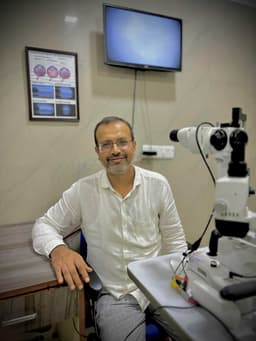
MBBS, MS (Ophthalmology) · Fellowship in Glaucoma, L V Prasad Eye Institute, Hyderabad
Gujarat Medical Council Reg. No. G-12281
Book a consultation
2nd Floor, Vinraj Plaza, opp. Government Press, Kothi Road, Anandpura, Vadodara, Gujarat 390001
Mon - Sat, 09:00 AM - 08:00 PM · Sunday closed
Start with a conversation.
Appointments
+91 81400 50055