
In this article
- The full guide
- Who should have a glaucoma check-up?
- Can glaucoma damage vision without symptoms?
- What tests are done in a glaucoma evaluation?
- Does high eye pressure always mean glaucoma?
- What happens on the day?
- What do the results mean?
- How often should the evaluation be repeated?
- Key Takeaways
- Final Thoughts
- Frequently asked questions
- ગુજરાતીમાં
Written by the Mungale Eye Hospital team
Medically reviewed by Dr. Sachin Mungale, MBBS, MS (Ophthalmology) · Fellowship in Glaucoma, L V Prasad Eye Institute, Hyderabad · Gujarat Medical Council Reg. No. G-12281 · Reviewed on 17 November 2026
Published 4 November 2026 · 7 min read
Who this page is for: Glaucoma is diagnosed from five tests together: pressure, corneal thickness, drainage angle, optic nerve and visual field. What each test does and when to have it.
Related on our site: Glaucoma Evaluation
The full guide
Glaucoma damages the optic nerve slowly, often without any warning signs. A single pressure reading cannot confirm or rule it out. A glaucoma evaluation puts several tests together to give a clear answer and a plan.
Who should have a glaucoma check-up?
The European Glaucoma Society guidelines (5th edition, 2021) and the AAO Primary Open-Angle Glaucoma Preferred Practice Pattern describe these risk factors:
- Age over 40, with risk rising each decade
- Family history, especially a parent, brother or sister with glaucoma
- Raised eye pressure found at a routine check
- High minus power (myopia) or high plus power (hyperopia), which is linked to angle closure
- Diabetes or long-standing high blood pressure
- Long-term steroid use, as drops, tablets, inhalers or creams
- A past eye injury or eye surgery
- Thin corneas found on pachymetry
If any of these apply, ask for a glaucoma evaluation rather than a pressure check alone. See glaucoma and family history.
Can glaucoma damage vision without symptoms?
Yes. The most common type, open-angle glaucoma, usually causes no pain and no early blur. It affects side vision first, and the brain fills in the gaps, so many people do not notice until the damage is advanced. In the Chennai Glaucoma Study of 3,850 adults over 40 in urban south India, over 90% of people found to have open-angle glaucoma did not know they had it. Vision lost to glaucoma cannot be restored, which is why testing before symptoms appear can help protect sight.
What tests are done in a glaucoma evaluation?
| Test | What it checks | Time | Discomfort |
|---|---|---|---|
| Tonometry | Eye pressure in mmHg | A few seconds per eye | Numbing drop; no pain |
| Pachymetry | Corneal thickness, which affects pressure readings | Under a minute | Numbing drop; no pain |
| Gonioscopy | Whether the drainage angle is open or narrow | A few minutes | A contact lens rests on the numbed eye |
| OCT and disc photographs | Optic nerve and nerve fibre layer | A few minutes | None; no contact |
| Perimetry (visual field) | Side vision, eye by eye | About 5 to 10 minutes per eye | None; needs concentration |
Eye pressure (tonometry)
Pressure is measured with a Goldmann applanation tonometer, the reference method, on the slit lamp. The hospital also has a Perkins hand-held tonometer, a Tono-Pen AVIA and an iCare IC100 rebound tonometer, which help when a patient cannot sit at the slit lamp, or the cornea is scarred or has had surgery.
Corneal thickness (pachymetry)
A Tomey SP-100 pachymeter measures corneal thickness in seconds. A thick cornea can make pressure read high, and a thin cornea can hide raised pressure and is itself a risk factor. See pachymetry.
Drainage angle (gonioscopy)
A special mirrored lens on the eye lets the doctor see the angle where fluid drains. This separates open-angle glaucoma from angle-closure disease, which is common in India and is treated differently.
Optic nerve (OCT and photographs)
Optical coherence tomography (OCT) measures the thickness of the nerve fibre layer around the optic nerve, and a fundus camera photographs the optic disc. Comparing these over time shows whether the nerve is stable or thinning.
Visual field (perimetry)
The ZEISS Humphrey Field Analyzer 3 maps your side vision. You look at a central light and press a button each time you see a faint flash. The test is repeated over time, because a single field can vary.
Does high eye pressure always mean glaucoma?
No. Many people have pressure above the usual range with a healthy optic nerve and normal fields. This is called ocular hypertension and needs monitoring, and sometimes treatment. Others develop glaucoma at normal pressure. That is why the nerve and fields matter as much as the number. See high eye pressure with normal vision.
What happens on the day?
- Bring your glasses, a list of medicines (including steroids) and any previous field, OCT or pressure reports.
- Tell the team if you have ever had sudden eye pain, haloes or been told your angles are narrow.
- Tests are usually done in this order: pressure, angle, fields, then dilating drops for the optic nerve photographs and OCT.
- Dilation blurs near vision for some hours. Do not drive yourself home.
What do the results mean?
- Normal: recheck at the interval your doctor advises.
- Glaucoma suspect: one or more findings are borderline; tests are repeated to look for change.
- Ocular hypertension: raised pressure with a healthy nerve; monitoring, and treatment if risk is high.
- Open-angle glaucoma: treatment to lower pressure, usually starting with drops. See glaucoma treatments.
- Angle closure: a laser or other treatment to open the angle may be advised.
How often should the evaluation be repeated?
It depends on the result. People with stable findings may be seen once a year or less often. Glaucoma suspects and people starting treatment are usually seen every few months at first. The EGS guidelines suggest several visual fields in the first two years after diagnosis, so the rate of change can be measured.
Key Takeaways
- Glaucoma is diagnosed from five tests together, not one pressure reading.
- Most glaucoma has no early symptoms.
- High pressure does not always mean glaucoma, and normal pressure does not rule it out.
- Repeat tests show whether anything is changing.
Final Thoughts
A glaucoma evaluation takes a little time but gives a clear picture of your eye health. To book one with Dr. Sachin Mungale, glaucoma specialist, at Mungale Eye Hospital, Kothi, Vadodara, call or WhatsApp +91 81400 50055, or plan your visit.
Medical Disclaimer: This page is general information. It does not replace an examination of your own eyes.
Frequently asked questions
Most glaucoma causes no pain or blur until it is advanced, because it affects side vision first and the brain fills in the gaps. In a large study in Chennai, over 90% of people with open-angle glaucoma did not know they had it. Testing before symptoms appear lets treatment start while vision is still good.
No. Glaucoma is damage to the optic nerve. High pressure is the main risk factor, but some people have glaucoma at normal pressure and many with high pressure never develop it. That is why the evaluation also checks the optic nerve with OCT and photographs, the side vision with a field test, and the drainage angle.
No. Numbing drops are used for the pressure check, corneal thickness and gonioscopy, so you feel only light contact. OCT, photographs and the field test involve no contact at all. Dilating drops may sting for a moment and blur near vision for some hours afterwards, so it is wise not to drive yourself home.
No. Damage to the optic nerve from glaucoma cannot be reversed with current treatment. Treatment aims to stop or slow further damage by lowering eye pressure, so the vision you have now is protected. This is why regular testing, taking drops as prescribed and keeping follow-up visits matter so much once glaucoma is found.
It depends on your results. If everything is normal, your doctor will advise a recheck interval, often every one to two years after 40. Glaucoma suspects and people starting treatment are usually seen every few months at first, with several field tests in the first two years. Stable patients may be seen once or twice a year.
Yes. Having a parent, brother or sister with glaucoma increases your own risk several times. Close relatives of someone with glaucoma should have a glaucoma evaluation from about the age of 40, or earlier if advised. Tell your eye doctor about any family history, as it changes how often you should be checked.
ગુજરાતીમાં
ઝામર (ગ્લોકોમા) ની તપાસમાં પાંચ વસ્તુ જોવાય છે: આંખનું પ્રેશર, કોર્નિયાની જાડાઈ, પાણી નીકળવાનો ખૂણો, ઓપ્ટિક નર્વ અને બાજુની નજર. માત્ર પ્રેશરથી ઝામર નક્કી થતું નથી. મોટા ભાગના ઝામરમાં શરૂઆતમાં કોઈ લક્ષણ હોતાં નથી.
40 વર્ષથી ઉપરના, પરિવારમાં ઝામર હોય, ડાયાબિટીસ હોય, વધારે નંબર હોય કે લાંબા સમયથી સ્ટીરોઈડ લેતા હોય તેમણે ઝામરની તપાસ કરાવવી જોઈએ.
Related questions this page covers
- Who should have a glaucoma check-up?
- Can glaucoma damage vision without symptoms?
- What tests are done in a glaucoma evaluation?
- Does high eye pressure always mean glaucoma?
- What happens on the day?
- What do the results mean?
- How often should the evaluation be repeated?
- I have no symptoms. Why do I need a glaucoma test?
- Is glaucoma just about eye pressure?
- Will the glaucoma tests hurt?
- Can vision lost to glaucoma be recovered?
- How often should a glaucoma evaluation be repeated?
- Does glaucoma run in families?
Author and medical reviewer
Prepared by the Mungale Eye Hospital team. Medically reviewed and approved by Dr. Sachin Mungale, MBBS, MS (Ophthalmology), Glaucoma Fellowship (L V Prasad Eye Institute, Hyderabad) · Gujarat Medical Council Reg. No. G-12281 · Last reviewed 17 November 2026
Sources
- European Glaucoma Society. Terminology and Guidelines for Glaucoma, 5th Edition. Br J Ophthalmol. 2021;105(Suppl 1):1 to 169. doi:10.1136/bjophthalmol-2021-egsguidelines
- Gedde SJ, Vinod K, Wright MM, et al. Primary Open-Angle Glaucoma Preferred Practice Pattern. Ophthalmology. 2021;128(1):P71 to P150.
- Vijaya L, George R, Baskaran M, et al. Prevalence of primary open-angle glaucoma in an urban south Indian population and comparison with a rural population: the Chennai Glaucoma Study. Ophthalmology. 2008;115(4):648 to 654.
- Kass MA, Heuer DK, Higginbotham EJ, et al. The Ocular Hypertension Treatment Study. Arch Ophthalmol. 2002;120(6):701 to 713.
- Mungale Eye Hospital website: glaucoma evaluation page (reviewed 3 October 2026) and Dr. Sachin Mungale's profile, for devices and the specialist named.
Reviewed by
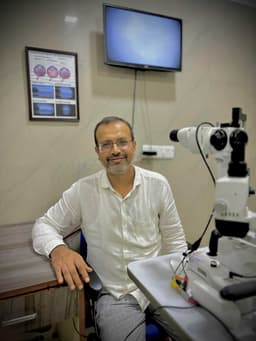
MBBS, MS (Ophthalmology) · Fellowship in Glaucoma, L V Prasad Eye Institute, Hyderabad
Gujarat Medical Council Reg. No. G-12281
Book a consultation
2nd Floor, Vinraj Plaza, opp. Government Press, Kothi Road, Anandpura, Vadodara, Gujarat 390001
Mon - Sat, 09:00 AM - 08:00 PM · Sunday closed
Start with a conversation.
Appointments
+91 81400 50055