
Written by the Mungale Eye Hospital team
Medically reviewed by Dr. Meeta Mungale, MBBS, MS (Ophthalmology), DNB · Fellowship in Cornea & Anterior Segment, L V Prasad Eye Institute, Hyderabad · Gujarat Medical Council Reg. No. G-39262 · Reviewed on 9 October 2026
Published 9 October 2026
Part of our guide: Corneal Transplant Surgery: When It Is Needed, Types, Recovery & Risks
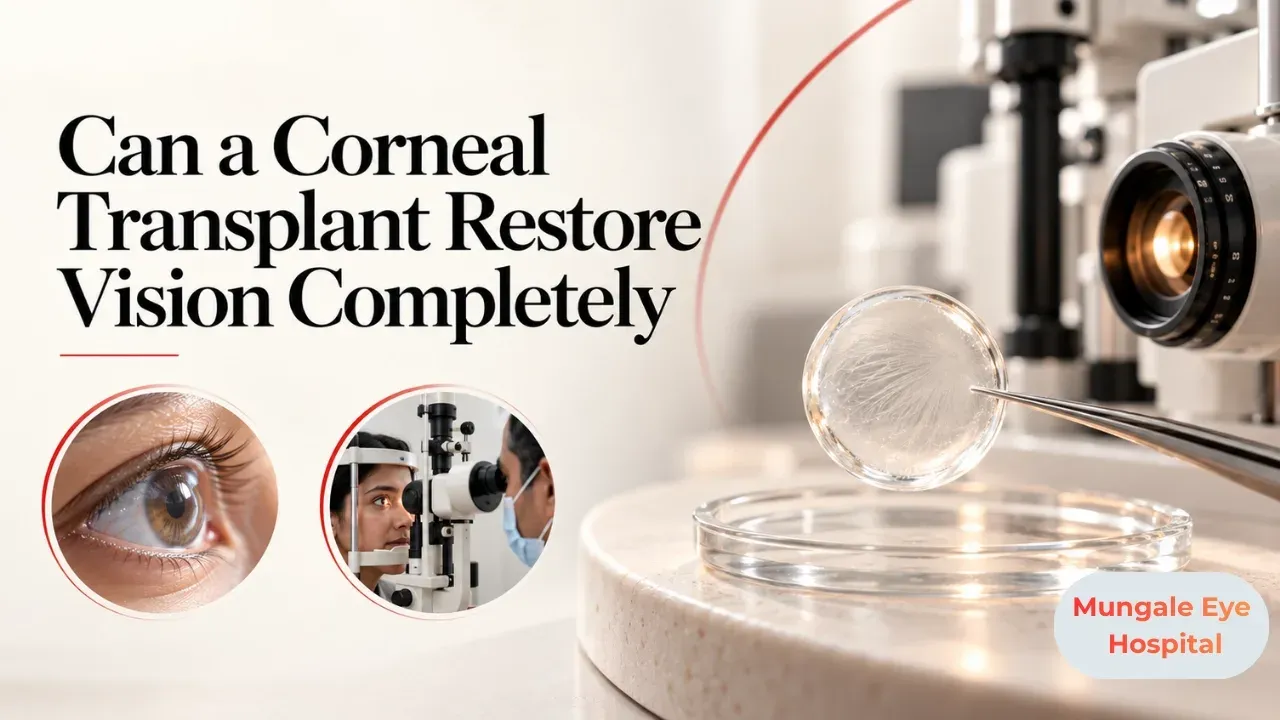
A corneal transplant replaces cloudy or damaged corneal tissue with clear donor tissue. Many patients experience a major improvement in vision. However, "complete" restoration depends on many factors, and most people still need glasses or contact lenses for their best vision.
What Affects the Final Vision?
Type of transplant
Endothelial transplants such as DMEK often give faster and sharper visual recovery. PK and DALK may leave more astigmatism due to stitches.
Original condition
Keratoconus and Fuchs' dystrophy often have good outcomes. Eyes with previous infections, chemical injuries or multiple surgeries may have more limited results.
Astigmatism
Irregular healing and stitches can cause astigmatism that blurs vision. Glasses, contact lenses, stitch adjustment or sometimes laser treatment can correct it.
Health of the rest of the eye
Retinal disease, glaucoma, amblyopia or cataract can limit vision even with a clear graft.
Ocular surface health
Dry eye, eyelid problems and surface disease affect comfort and clarity.
Complications
Rejection, infection, high eye pressure and graft failure can reduce vision.
Why Might You Still Need Glasses or Lenses?
The new cornea's shape is rarely perfect. Many patients need glasses or rigid or scleral contact lenses after surgery for the sharpest vision, especially after PK or DALK.
How Long Before Final Vision Is Known?
Vision after DMEK may stabilise within a few months. After PK or DALK, stabilisation can take a year or more, especially until stitches are adjusted or removed.
How Can You Improve Your Outcome?
What Is a Realistic Expectation?
Most patients gain significant improvement compared with before surgery, allowing better daily function. Some achieve excellent vision, while others gain more modest improvement depending on eye health. Your surgeon will discuss your expected outcome before surgery.
Key Takeaways
Final Thoughts
A corneal transplant can bring meaningful improvement in sight, and understanding the factors involved helps set realistic expectations. Dr. Meeta Mungale and the team at Mungale Eye Hospital in Vadodara counsel patients carefully before and after transplant surgery.
Frequently Asked Questions
Vision often improves significantly, but perfect vision is not guaranteed. Many patients still need glasses or contact lenses, and results depend on the transplant type and overall eye health.
Blurry vision can result from healing, swelling, astigmatism from stitches or other eye conditions. Vision usually improves over months. Your surgeon may adjust stitches or prescribe lenses.
After DMEK, many patients see well within a few months. After PK or DALK, it may take a year or longer for vision to stabilise.
Some patients need rigid or scleral contact lenses for the sharpest vision, particularly with irregular astigmatism after PK or DALK. Glasses may be enough for others.
Yes. Retinal disease, glaucoma, cataract, amblyopia and dry eye can limit vision even if the graft is clear. Your surgeon will assess these before surgery.
Sources and further reading
Reviewed by
MBBS, MS (Ophthalmology), DNB · Fellowship in Cornea & Anterior Segment, L V Prasad Eye Institute, Hyderabad
Gujarat Medical Council Reg. No. G-39262
Book a consultation
2nd Floor, Vinraj Plaza, opp. Government Press, Kothi Road, Anandpura, Vadodara, Gujarat 390001
Mon - Sat, 09:00 AM - 08:00 PM · Sunday closed
Related Articles
Start with a conversation.
Appointments
+91 81400 50055