
Written by the Mungale Eye Hospital team
Medically reviewed by Dr. Meeta Mungale, MBBS, MS (Ophthalmology), DNB · Fellowship in Cornea & Anterior Segment, L V Prasad Eye Institute, Hyderabad · Gujarat Medical Council Reg. No. G-39262 · Reviewed on 8 October 2026
Published 8 October 2026
Part of our guide: Corneal Transplant Surgery: When It Is Needed, Types, Recovery & Risks
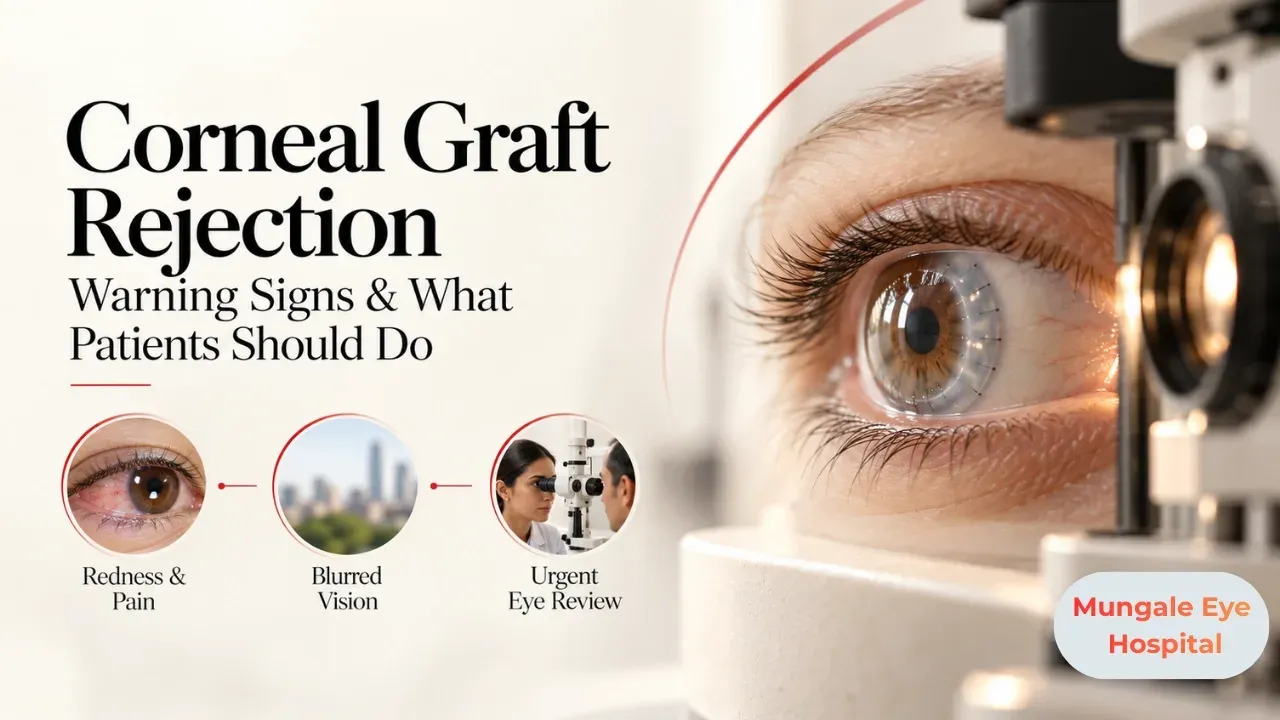
Corneal graft rejection happens when the body's immune system recognises donor corneal tissue as foreign and attacks it. It can occur weeks, months or even years after a transplant. The good news is that many rejection episodes can be reversed when treated promptly.
Why Does Rejection Happen?
The immune system normally protects the body from foreign tissue. The cornea has some natural protection because it lacks blood vessels, but rejection can still occur. Rejection of the endothelium, the inner layer, is most serious because these cells are essential for keeping the cornea clear.
What Are the Warning Signs?
Some people notice only one sign, so any change should be reported.
Who Is at Higher Risk?
How Is Rejection Diagnosed?
Your eye surgeon examines the graft with a slit lamp, looking for inflammation, rejection lines, keratic precipitates and corneal swelling. Corneal thickness measurements may help.
How Is Rejection Treated?
What Happens If the Graft Fails?
If rejection cannot be reversed and the graft becomes permanently cloudy, a repeat transplant may be considered after inflammation settles.
How Can You Lower the Risk?
Key Takeaways
Final Thoughts
Knowing the warning signs and acting quickly can save a corneal graft. Keep your drops, appointments and emergency contacts close at hand. Dr. Meeta Mungale and the team at Mungale Eye Hospital in Vadodara provide long-term care for corneal transplant patients.
Frequently Asked Questions
The main signs are redness, sensitivity to light, decreased vision and pain, remembered as RSVP. Any of these should prompt same-day contact with your eye surgeon.
Yes, many rejection episodes can be reversed if treated early with intensive steroid drops and close monitoring. Delayed treatment increases the risk of graft failure.
Rejection can happen at any time, from weeks to many years after surgery, though risk is highest in the first year or two.
Lamellar procedures such as DMEK and DALK generally have lower rejection risk than full-thickness PK.
Restart as soon as you remember and follow your surgeon's schedule. Missing drops can increase rejection risk. Contact your surgeon if you have missed several doses.
Sources and further reading
Reviewed by

MBBS, MS (Ophthalmology), DNB · Fellowship in Cornea & Anterior Segment, L V Prasad Eye Institute, Hyderabad
Gujarat Medical Council Reg. No. G-39262
Book a consultation
2nd Floor, Vinraj Plaza, opp. Government Press, Kothi Road, Anandpura, Vadodara, Gujarat 390001
Mon - Sat, 09:00 AM - 08:00 PM · Sunday closed
Related Articles
Start with a conversation.
Appointments
+91 81400 50055