
Written by the Mungale Eye Hospital team
Medically reviewed by Dr. Meeta Mungale, MBBS, MS (Ophthalmology), DNB · Fellowship in Cornea & Anterior Segment, L V Prasad Eye Institute, Hyderabad · Gujarat Medical Council Reg. No. G-39262 · Reviewed on 7 October 2026
Published 7 October 2026
Part of our guide: Corneal Transplant Surgery: When It Is Needed, Types, Recovery & Risks
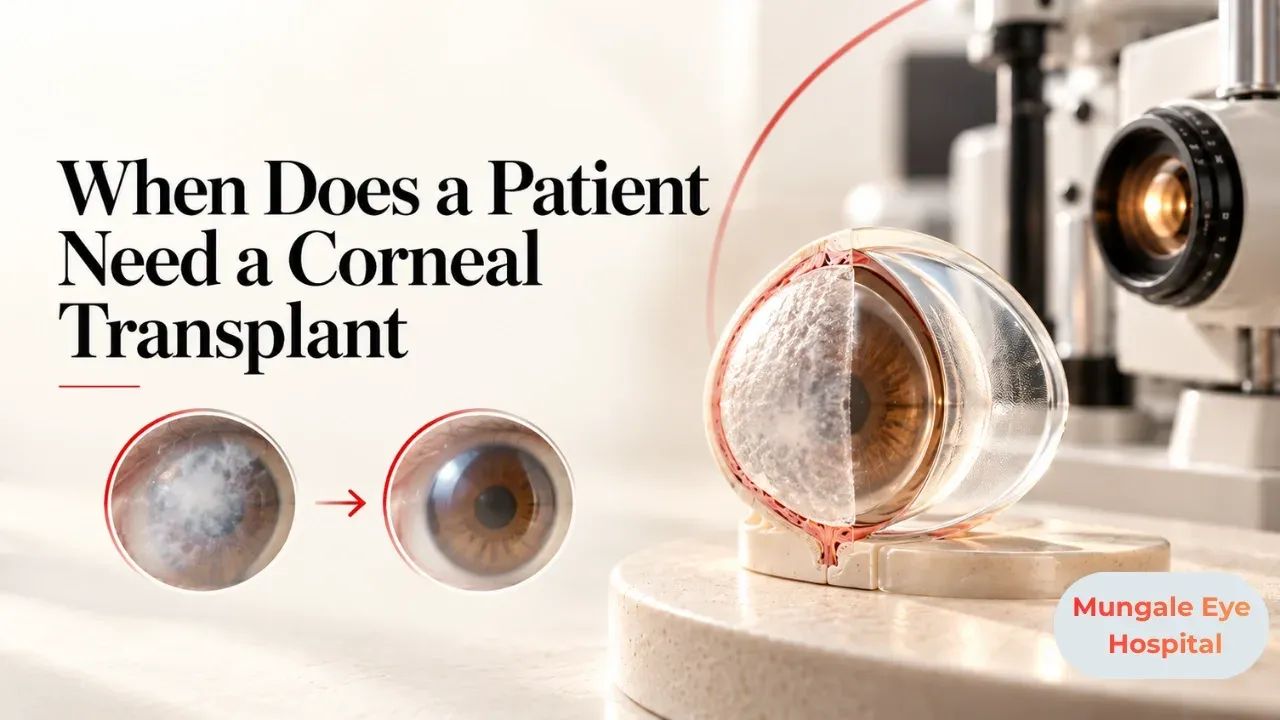
A corneal transplant, also called keratoplasty, is surgery that replaces all or part of a damaged or diseased cornea with healthy donor tissue. The cornea is the clear front window of the eye. When it becomes cloudy, scarred, swollen or misshapen, vision can be severely affected, and a transplant may be needed.
Which Conditions May Need a Transplant?
Advanced keratoconus
When the cornea is very thin or scarred and lenses no longer give useful vision.
Corneal scarring
Scars from infections such as corneal ulcers, trauma, chemical injury or inflammation.
Fuchs' endothelial dystrophy
An inherited condition in which the inner layer of cells that pump fluid out of the cornea fails, causing swelling and cloudy vision.
Corneal swelling after eye surgery
Some patients develop corneal oedema after cataract or other eye surgery.
Corneal thinning or perforation
Severe infection or inflammation can thin the cornea, risking or causing a perforation that needs urgent surgery.
Failed previous graft
A graft that has failed may need replacement.
Corneal dystrophies and degenerations
Other inherited or age-related conditions that cloud the cornea.
When Is a Transplant Considered?
Doctors consider transplant when:
Are There Alternatives?
Depending on the condition, alternatives may include cross-linking for keratoconus, scleral lenses, intracorneal rings, medicines and hypertonic drops for mild swelling, or laser treatments for surface scars. Your surgeon will discuss options before recommending a transplant.
What Are the Types of Transplant?
Modern surgery often replaces only the diseased layer:
What Assessment Happens Before Surgery?
The surgeon examines the eye, measures corneal thickness and shape, checks eye pressure and retina, and discusses expectations, risks and follow-up. Corneal tissue comes from eye banks.
Key Takeaways
Final Thoughts
A corneal transplant can restore sight and relieve pain for many people. Careful assessment determines whether it is the right option and which type suits you. Dr. Meeta Mungale and the team at Mungale Eye Hospital in Vadodara offer advanced corneal transplant procedures.
Frequently Asked Questions
People with a cornea that is scarred, swollen, very thin or misshapen enough to cause poor vision or pain, and who cannot be helped by glasses, lenses or other treatments, may need a transplant.
Common reasons include advanced keratoconus, corneal scarring after infection or injury, Fuchs' endothelial dystrophy, corneal swelling after eye surgery and failed previous grafts.
No. Most keratoconus patients are managed with cross-linking, glasses or special lenses. Transplant is reserved for advanced cases with scarring or poor vision despite lenses.
Donor corneas come from eye banks, which collect and screen tissue donated after death. Eye donation is vital for transplant surgery.
Many corneal transplants succeed, especially partial thickness procedures in low-risk eyes. Success depends on the underlying condition, transplant type and careful follow-up.
Sources and further reading
Reviewed by

MBBS, MS (Ophthalmology), DNB · Fellowship in Cornea & Anterior Segment, L V Prasad Eye Institute, Hyderabad
Gujarat Medical Council Reg. No. G-39262
Book a consultation
2nd Floor, Vinraj Plaza, opp. Government Press, Kothi Road, Anandpura, Vadodara, Gujarat 390001
Mon - Sat, 09:00 AM - 08:00 PM · Sunday closed
Related Articles
Start with a conversation.
Appointments
+91 81400 50055