
Written by the Mungale Eye Hospital team
Medically reviewed by Dr. Meeta Mungale, MBBS, MS (Ophthalmology), DNB · Fellowship in Cornea & Anterior Segment, L V Prasad Eye Institute, Hyderabad · Gujarat Medical Council Reg. No. G-39262 · Reviewed on 11 October 2026
Published 11 October 2026
Part of our guide: Pterygium: Causes, Symptoms, Stages, Treatment & Surgery
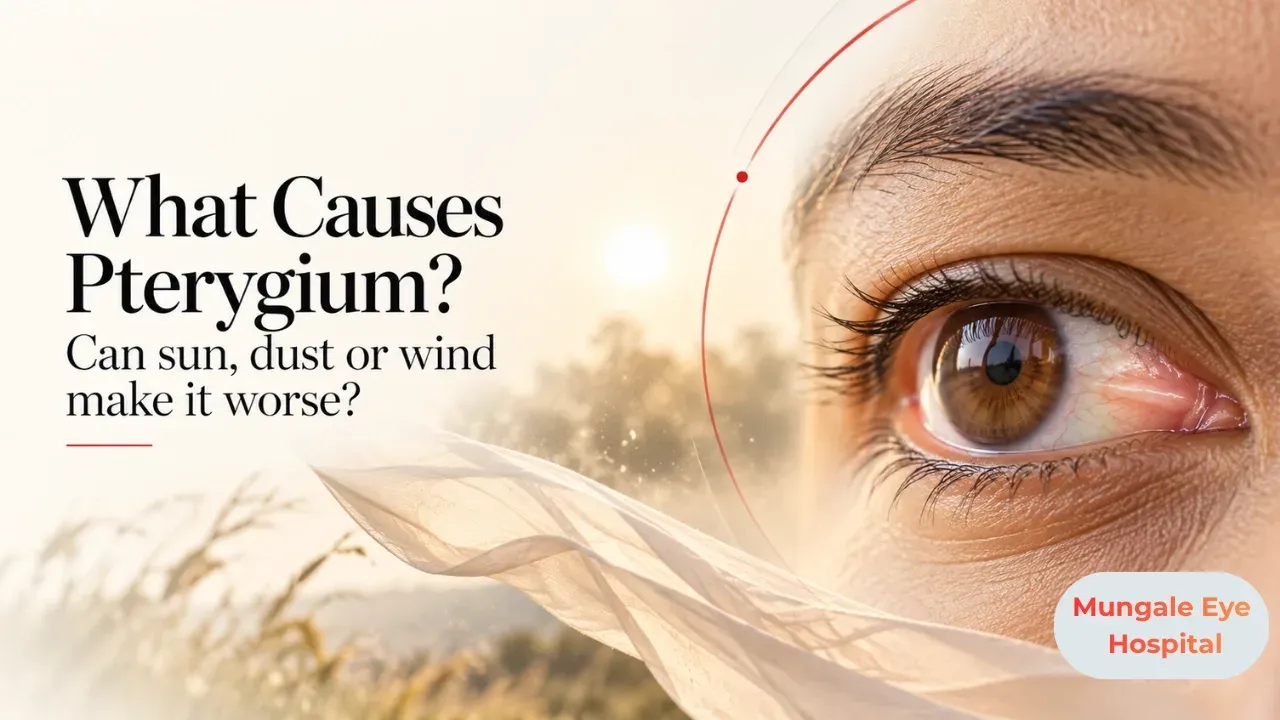
Pterygium is a raised, wedge-shaped growth of tissue that starts on the white of the eye and can slowly grow onto the cornea. Its main cause is long-term exposure to ultraviolet (UV) light from the sun. Dust, wind and dry air add to the irritation and can make it grow or become red more often.
What Exactly Is a Pterygium?
It is a growth of the conjunctiva, the thin clear layer over the white of the eye. It usually starts on the side nearest the nose and grows toward the centre of the eye. It is not cancer. Small pterygia may cause no symptoms, while larger ones can affect vision by pulling on the cornea or covering the pupil area.
Why Does Sun Exposure Cause It?
UV light damages the cells at the edge of the cornea, called limbal stem cells. These cells normally act as a barrier between the conjunctiva and the cornea. When they are damaged, the conjunctiva can grow onto the cornea. Light reflected from sand, water and roads can focus on the inner corner of the eye, which explains why pterygium usually starts there.
How Do Dust and Wind Contribute?
Dust and wind do not cause pterygium alone, but they:
In many parts of Gujarat, bright sun, heat and dust combine, so outdoor workers face a higher overall risk.
Who Is at Higher Risk?
What Are the Symptoms?
How Can You Protect Your Eyes?
Key Takeaways
Final Thoughts
Pterygium is common in sunny places, but it is largely preventable with simple daily habits. If you already have a growth, regular checks help decide if and when treatment is needed. For an assessment, you can consult Dr. Meeta Mungale, an ophthalmologist at Mungale Eye Hospital in Vadodara.
Frequently Asked Questions
Pterygium is not cancer and is usually not dangerous. However, if it grows onto the cornea, it can change the shape of the eye and blur vision. Regular checks help decide when removal is needed.
No. A pterygium does not disappear naturally. Drops can reduce redness and irritation, but only surgery can remove the growth. Many small pterygia stay stable for years and need only monitoring.
UV-blocking sunglasses greatly reduce the risk and can slow the growth of an existing pterygium. Wraparound styles work best because they block light from the sides. A hat adds extra protection.
It can appear in one or both eyes. Both eyes are usually exposed to similar sunlight, so people with one pterygium often develop changes in the other eye too. Both eyes should be checked.
No. Pterygium is a growth on the eye surface, while cataract is clouding of the lens inside the eye. Both are linked with sun exposure, but they are separate conditions with different treatments.
No. Screens do not emit the kind of UV exposure linked to pterygium. Outdoor sunlight is the main cause. Screen use can worsen dryness, which may make an existing pterygium feel more irritated.
Sources and further reading
Reviewed by

MBBS, MS (Ophthalmology), DNB · Fellowship in Cornea & Anterior Segment, L V Prasad Eye Institute, Hyderabad
Gujarat Medical Council Reg. No. G-39262
Book a consultation
2nd Floor, Vinraj Plaza, opp. Government Press, Kothi Road, Anandpura, Vadodara, Gujarat 390001
Mon - Sat, 09:00 AM - 08:00 PM · Sunday closed
Related Articles
Start with a conversation.
Appointments
+91 81400 50055